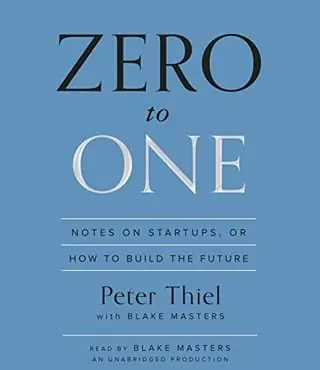
Zero to One summary
by Peter Thiel with Blake Masters · 2014 · 8 key ideas · 24-minute read
Real progress comes from creating something genuinely new, and the best way to do that is to build a small, defensible monopoly instead of fighting in a crowded market.
Why read it
For founders, investors and anyone choosing what to work on. It is a short, provocative book that challenges comfortable startup clichés about competition, disruption and diversification.
Zero to One in brief
Thiel distinguishes two kinds of progress. Going from one to n means copying things that already work, which spreads existing ideas across the world. Going from zero to one means making something new that did not exist before. He argues that the future depends on the second kind, and that a startup is simply the best vehicle we have for doing it.
His most contrarian claim is that competition destroys value for the people doing the competing. In a perfectly competitive market, profits are driven towards zero. The businesses that endure are creative monopolies: companies so much better at one thing that nobody offers a close substitute. Such companies can afford to think long term, treat employees well and keep investing in innovation.
To get there, start with a small market you can dominate, then expand to adjacent ones. Durable monopolies tend to share four traits: proprietary technology that is far better than the alternative, network effects, economies of scale and a strong brand. What matters is not being the first mover but the last mover: the company still making money decades from now.
Thiel also argues for a definite view of the future. Instead of treating life and business as a lottery, make concrete plans. Venture returns follow a power law, where one success can outweigh everything else, so focus on the few things that could matter enormously. Every great business is built on a secret, an important truth most people have missed.
The book closes with practical advice: get the founding team, ownership and board right from day one, because foundations are hard to fix later; build a mission-driven culture; take distribution as seriously as product; and use technology to complement human judgment rather than replace it.
The 8 key ideas
1. Zero to one, not one to n
Copying spreads progress. Creating makes it.
2. Competition is for losers
Don't win the fight. Make the fight unnecessary.
3. The lies companies tell about markets
If your market only exists in your pitch deck, you have none.
4. Start small, monopolize, then expand
Own a pond before you fish the ocean.
5. Be definite about the future
You are not a lottery ticket.
6. The power law
One big win outweighs a hundred small ones.
7. There are still secrets
If everyone already agrees, it's not a secret.
8. Seven questions every business must answer
A great product without distribution is a secret no one hears.
Read the full guide in Kinquire. Every idea with a real example, a diagram and one thing to try today, plus a quick quiz so it sticks. Free to start.
Read Zero to OneKey takeaways
- Before starting, write down what is genuinely new about your idea rather than a slightly better copy.
- Pick a small, well-defined market you could realistically dominate, then plan the next adjacent one.
- Describe your market honestly, including indirect substitutes, before you decide what to charge.
- Make a concrete plan for the next few years instead of keeping every option open.
- Put your best effort into the one project with the largest possible upside.
- Design distribution as carefully as the product itself.
Our take
Zero to One is sharp, quotable and useful for making founders question easy assumptions, especially that competition is healthy for the competitors and that copying is progress. Its weaknesses come from the same boldness: sweeping generalisations about nations and generations, little evidence beyond Thiel's own experience, and examples chosen with hindsight. The praise of monopoly sits awkwardly with later public worries about tech platforms' power. It also reflects a Silicon Valley venture lens that suits a narrow kind of high-growth company. Read it as a set of challenging questions rather than a proven method.
About Peter Thiel with Blake Masters
Peter Thiel co-founded PayPal and Palantir and was an early outside investor in Facebook. The book grew out of notes that his student Blake Masters took on Thiel's 2012 Stanford course on startups.
If you liked this
- The Lean Startup by Eric Ries
- Crossing the Chasm by Geoffrey A. Moore
- Blitzscaling by Reid Hoffman and Chris Yeh
- The Innovator's Dilemma by Clayton M. Christensen
- The Hard Thing About Hard Things by Ben Horowitz
- The E-Myth Revisited by Michael E. Gerber