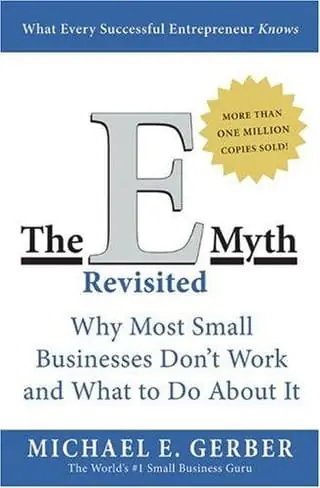
The E-Myth Revisited summary
by Michael E. Gerber · 1995 · 8 key ideas · 21-minute read
Most small businesses are run by skilled technicians who end up trapped doing the work, and the escape is to build the business as a system that works without you.
Why read it
For anyone who runs or plans to run a small business, especially people who turned a craft or trade into a company and now feel the business owns them.
The E-Myth Revisited in brief
Gerber's E-Myth, short for entrepreneurial myth, is the belief that most small businesses are started by entrepreneurs. In his experience, most are started by technicians: people skilled at a trade who decide to work for themselves. Their fatal assumption is that understanding the technical work of a business means understanding how to run a business that does that work.
Inside every owner, he argues, three personalities compete: the Entrepreneur who dreams, the Manager who organises and the Technician who does the work. In most small businesses the Technician dominates, so the owner works harder and harder in a business that cannot run without them, through the stages of infancy and adolescence, often without reaching maturity.
His answer is to work on your business, not just in it. Treat the business itself as the product, and design it like a franchise prototype: a model where every task is documented and systematised so that ordinary people can deliver consistent results. McDonald's under Ray Kroc is his central example of this turn-key thinking.
The book ends with a practical program: define your primary aim for your life, set a strategic objective for the business, draw the organisation chart before you hire, and build management, people, marketing and systems strategies. Throughout, Gerber tells the story of Sarah, a pie maker overwhelmed by the shop she loves.
The 8 key ideas
1. The fatal assumption
Being good at the work isn't the same as running the business.
2. Entrepreneur, Manager, Technician
Let the Technician work, but don't let them steer.
3. Infancy, adolescence, maturity
Delegating without a system is abdicating.
4. Work on your business, not in it
Build the machine, not just the product.
5. Think like a franchise prototype
If it isn't written down, it isn't a system.
6. Draw the organisation chart first
Hire for a box, not for a burden.
7. Start with your primary aim
Design your life first, then the business that serves it.
8. Innovate, quantify, orchestrate
Try it, count it, make it routine.
Read the full guide in Kinquire. Every idea with a real example, a diagram and one thing to try today, plus a quick quiz so it sticks. Free to start.
Read The E-Myth RevisitedKey takeaways
- List the tasks only you can do and start documenting everything else.
- Schedule regular time to work on your business instead of in it.
- Write your primary aim before setting goals for the business.
- Draw your future organisation chart and write a short contract for each role.
- Turn your best methods into checklists that a new person could follow.
- Test small improvements, measure them and make the winners standard.
Our take
The E-Myth Revisited has helped countless owners see why they feel trapped, and its core advice, systemise, document and work on the business, remains sound and widely taught. Its weaknesses are also clear. Much of the book is repetitive, the Sarah dialogues can feel contrived, and its failure statistics are overstated. The franchise model fits some businesses better than others; where the owner's craft is the product, full systemisation may not be wanted. It also offers more philosophy than step-by-step detail. Read it for the mindset shift, then pair it with more practical guides.
About Michael E. Gerber
Michael E. Gerber is a small-business consultant who founded a firm that coached thousands of owners. This book is an updated version of his 1986 book The E-Myth.
If you liked this
- Built to Sell by John Warrillow
- Company of One by Paul Jarvis
- Profit First by Mike Michalowicz
- Zero to One by Peter Thiel with Blake Masters
- The Lean Startup by Eric Ries
- The Hard Thing About Hard Things by Ben Horowitz