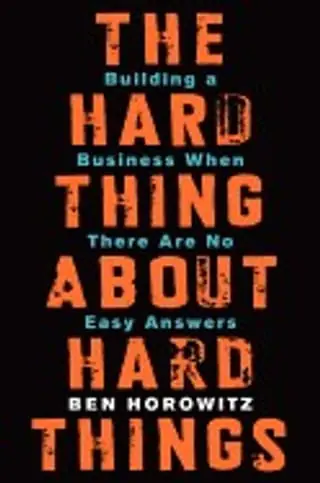
The Hard Thing About Hard Things summary
by Ben Horowitz · 2014 · 7 key ideas · 19-minute read
Running a company is mostly about handling situations with no clear answer, and the best preparation is honest stories from someone who survived them.
Why read it
For founders, CEOs and managers who face decisions that no business school case quite fits: layoffs, firing friends, hiring executives and keeping going when everything is failing.
The Hard Thing About Hard Things in brief
Horowitz starts with his own story. He co-founded Loudcloud in 1999, took it public in 2001 as the dot-com bubble burst, cut staff repeatedly, sold off its main services business and rebuilt the remaining software company as Opsware. Years of near-death moments ended with a sale to HP in 2007 for about $1.6 billion.
From that experience he argues that management books describe easy problems. The hard things, such as when to lay people off, whether to demote a loyal friend or how to tell the company bad news, have no formula. What helps is practical wisdom and the stomach to act.
Much of the book is that practical wisdom. Take care of people first, then products, then profits. Lay people off with dignity and in person. Hire executives for their strengths, not their lack of weaknesses. Avoid management debt, the short-term fixes that cost you later. Tell people the truth, because a company that hides problems cannot solve them.
He also writes about the CEO's own psychology. He calls the worst moments the Struggle, when nothing works and quitting looks sensible. He distinguishes wartime from peacetime leadership, and argues that the most important skill for a CEO is managing their own mind well enough to keep making decisions.
The 7 key ideas
1. There is no recipe
No silver bullets. Only lead bullets.
2. Tell it like it is
Bad news travels; make sure it travels from you.
3. People, products, profits, in that order
Look after the people and they'll look after the product.
4. Lay people off the right way
How you treat those who leave tells those who stay everything.
5. Wartime and peacetime CEOs
Know if you're at peace or at war.
6. Hire for strength, not lack of weakness
Hire the spike, not the smooth line.
7. Beware management debt
Easy now, expensive later.
Read the full guide in Kinquire. Every idea with a real example, a diagram and one thing to try today, plus a quick quiz so it sticks. Free to start.
Read The Hard Thing About Hard ThingsKey takeaways
- Share problems early with the people who can help fix them.
- Put people first, because products and profits depend on them.
- If you must cut jobs, act quickly, own the decision and let managers tell their own people.
- Judge whether your situation is peacetime or wartime and lead accordingly.
- Hire for exceptional strength in what matters most, not for the absence of flaws.
- Pay down management debt before it compounds.
Our take
This is one of the most candid books about running a company, and its advice on layoffs, executive hiring and management debt is concrete and often used. Its strength is also its limit: it is built mostly from one founder's experience in enterprise software during a crash, so some lessons may not transfer to calmer markets or smaller businesses. It gives little systematic evidence, and its wartime language can be read as licence for harsh leadership. Readers looking for a structured method will be disappointed; readers who want an honest account of hard decisions will find it valuable.
About Ben Horowitz
Ben Horowitz co-founded Loudcloud, which became Opsware and was sold to Hewlett-Packard in 2007. In 2009 he co-founded the venture capital firm Andreessen Horowitz with Marc Andreessen.
If you liked this
- High Output Management by Andrew S. Grove
- Zero to One by Peter Thiel with Blake Masters
- The Lean Startup by Eric Ries
- The E-Myth Revisited by Michael E. Gerber
- $100M Offers by Alex Hormozi
- $100M Leads by Alex Hormozi