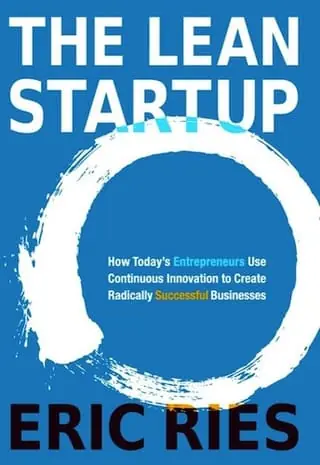
The Lean Startup summary
by Eric Ries · 2011 · 8 key ideas · 21-minute read
Startups fail less when they treat every plan as a hypothesis, test it quickly with real customers and learn their way to a product people actually want.
Why read it
For founders, product managers and anyone launching something new inside a company. It replaces the long secret build and big launch with a disciplined, scientific way of learning what works.
The Lean Startup in brief
Ries defines a startup as a human institution that creates a new product or service under conditions of extreme uncertainty. That definition covers a two-person app and a new team inside a large company. Because the uncertainty is extreme, traditional management, with detailed plans and forecasts, does not work. Yet abandoning management altogether does not work either.
His alternative is borrowed from lean manufacturing at Toyota. The real unit of progress for a startup is validated learning: evidence, gathered from real customers, about what creates value. Every plan rests on leap-of-faith assumptions, and the job is to test the riskiest ones as early and cheaply as possible.
The engine for this is the Build-Measure-Learn feedback loop. Build a minimum viable product, the smallest thing that can test a hypothesis; measure how real customers respond; then learn whether to persevere or pivot. Speed through the loop matters more than polish. Innovation accounting keeps everyone honest by tracking actionable metrics rather than vanity numbers that only ever go up.
The final part covers how to accelerate. Work in small batches so problems surface early. Understand which engine of growth you are using: sticky, viral or paid. Use techniques like the Five Whys to fix root causes without slowing down. The aim is an organisation that can keep experimenting, in a startup or inside an established company.
The 8 key ideas
1. Entrepreneurship is management
Uncertainty needs management, just a different kind.
2. Validated learning
Learning you can't measure is just a story.
3. Build, measure, learn
Shorten the loop, sharpen the learning.
4. Test leaps of faith with an MVP
Build the least, learn the most.
5. Innovation accounting
If a number only goes up, it isn't telling you anything.
6. Pivot or persevere
A pivot changes direction, not destination.
7. Small batches win
Find the mistake on envelope one, not envelope one thousand.
8. Know your engine of growth
Pick one engine and tune it.
Read the full guide in Kinquire. Every idea with a real example, a diagram and one thing to try today, plus a quick quiz so it sticks. Free to start.
Read The Lean StartupKey takeaways
- List the leap-of-faith assumptions behind your idea and test the riskiest one first.
- Plan experiments in reverse: decide what to learn, then what to measure, then what to build.
- Launch the smallest thing that can produce real customer evidence.
- Replace vanity metrics with cohort-based, actionable numbers.
- Schedule regular pivot-or-persevere reviews instead of drifting.
- Ship in small batches so problems show up early.
Our take
The Lean Startup changed how products are built: MVPs, pivots and cohort metrics are now standard, and its core insight, test assumptions before scaling, has held up well. Its limits are real, though. The method fits software and consumer products better than deep tech, hardware or regulated fields where experiments are slow and costly. Critics, including Peter Thiel, argue that endless iteration can replace vision and produce timid, incremental products. Many examples come from Ries's own circle, and MVP is often misused as an excuse to ship poor work. Used with judgement, it remains one of the most practical startup books.
About Eric Ries
Eric Ries co-founded the virtual-world company IMVU, where many of the book's ideas were developed. He later founded the Long-Term Stock Exchange.
If you liked this
- The Mom Test by Rob Fitzpatrick
- Zero to One by Peter Thiel with Blake Masters
- The Hard Thing About Hard Things by Ben Horowitz
- The E-Myth Revisited by Michael E. Gerber
- $100M Offers by Alex Hormozi
- $100M Leads by Alex Hormozi