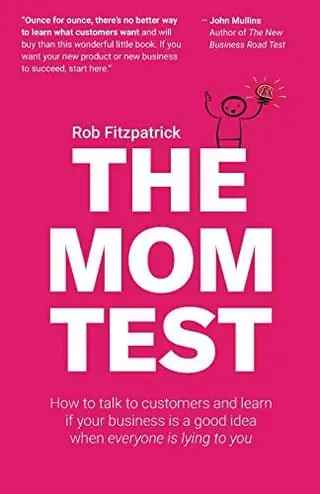
The Mom Test summary
by Rob Fitzpatrick · 2013 · 7 key ideas · 18-minute read
Everyone lies to you about your idea to be nice, so ask about their real lives and past behaviour instead, and you'll get the truth even from your mum.
Why read it
For anyone testing a business idea, a product or a feature with potential customers. It is short, practical and fixes the most common mistake in customer research.
The Mom Test in brief
Fitzpatrick's premise is that people will lie to you about your idea, not out of malice but kindness. Ask anyone, especially your mum, whether your idea is good and they will say yes. That false encouragement leads founders to spend months building things nobody will pay for.
The Mom Test is a set of rules for asking questions so good that even your mother can't lie to you. Talk about their life rather than your idea. Ask about specific things they did in the past rather than opinions about the future. Talk less and listen more.
He then shows how to handle bad data: deflect compliments, pin down vague fluff and dig beneath feature requests to find the motivation. Prepare the few scary questions that could kill your idea, keep conversations casual and short, and choose a customer segment narrow enough to know exactly where to find people.
Finally, judge meetings by commitment. A good conversation ends with the customer giving up something real, such as time, reputation or money, to move forward. If all you got was a compliment, you learned nothing. Learning from customers is a team responsibility, so take notes and share them.
The 7 key ideas
1. The three rules
Ask about their life, not your idea.
2. Spot compliments, fluff and ideas
Compliments are the fool's gold of customer learning.
3. Don't pitch, learn
If you're pitching, you're not learning.
4. Look before you zoom
If they haven't tried to fix it, they won't pay you to.
5. Ask the scary questions
Bad news early is cheaper than bad news late.
6. Measure commitment, not compliments
If it cost them nothing, it means nothing.
7. Keep it casual, choose a sharp segment
If you can't say where to find them, you haven't found your segment.
Read the full guide in Kinquire. Every idea with a real example, a diagram and one thing to try today, plus a quick quiz so it sticks. Free to start.
Read The Mom TestKey takeaways
- Ask about specific past events instead of opinions about your idea.
- Deflect compliments and dig beneath feature requests to the real motivation.
- Write your three most important questions before every customer conversation.
- End every meeting by asking for a concrete commitment.
- Narrow your customer segment until you know exactly where to find them.
- Take notes and share learnings with your team.
Our take
The Mom Test is short, clear and immediately useful; its rules for asking about past behaviour are now standard advice in startup programmes and product teams. Its limits: it focuses on early interviews, so it says little about later stages such as pricing experiments or large-scale research. The examples are mostly from software and B2B startups. Some researchers note that conversations, however well run, can't replace observing real behaviour or running experiments, a point the book partly acknowledges by stressing commitment. As a guide to talking with customers honestly, few books are more practical.
About Rob Fitzpatrick
Rob Fitzpatrick is an entrepreneur who learned these lessons by founding startups. He has also written Write Useful Books, about creating practical non-fiction.
If you liked this
- The Lean Startup by Eric Ries
- SPIN Selling by Neil Rackham
- Traction by Gabriel Weinberg and Justin Mares
- Zero to One by Peter Thiel with Blake Masters
- The Hard Thing About Hard Things by Ben Horowitz
- The E-Myth Revisited by Michael E. Gerber