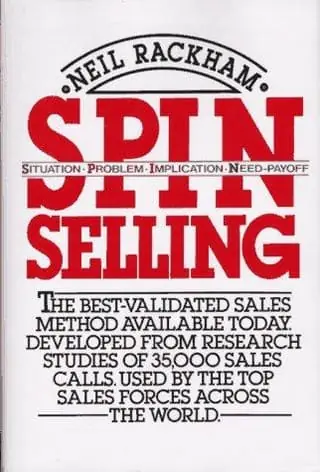
SPIN Selling summary
by Neil Rackham · 1988 · 8 key ideas · 20-minute read
In large, complex sales, success comes not from clever closes but from asking the right sequence of questions — Situation, Problem, Implication, Need-payoff — so the buyer discovers the value of a solution for themselves.
Why read it
For anyone selling expensive products, services or ideas that need a considered decision. It is one of the few sales books built on large-scale observational research rather than personal anecdote.
SPIN Selling in brief
Rackham's team set out to answer a simple question: what do successful salespeople actually do differently in a sales call? They observed tens of thousands of real calls over more than a decade, and found that the classic sales training of the day — built around opening benefits, objection handling and closing techniques — was designed for small, quick sales and often failed in large ones.
In a large sale, the decision takes time, involves many people and carries real risk for the buyer. Pressure tactics that work in a one-off purchase backfire, and the relationship matters. The key stage of a large sale turns out to be investigating: finding and developing the customer's needs.
Successful sellers do this with a pattern of questions. Situation questions gather facts. Problem questions uncover difficulties. Implication questions explore the consequences of those problems, making them feel larger and more urgent. Need-payoff questions get the customer to describe the value of solving them. This moves buyers from vague dissatisfaction to explicit needs.
The rest of the book shows how this changes everything else: how to present your capabilities as benefits rather than advantages, how to prevent objections instead of handling them, how to judge progress by advances rather than closes, and how to put the model into practice by learning one behaviour at a time.
The 8 key ideas
1. Big sales play by different rules
A big sale is a decision, not an impulse.
2. The four stages of a call
Openers matter less than the questions that follow.
3. Turn implied needs into explicit ones
Grumbles don't buy; needs do.
4. Situation and Problem questions
Research the facts; ask about the pain.
5. Implication and Need-payoff questions
Let the problem grow, then let them name the cure.
6. Benefits, not advantages
No stated need, no benefit.
7. Prevent objections, don't handle them
Objections are usually self-inflicted.
8. Seek advances, not closes
Every call should move the deal one real step.
Read the full guide in Kinquire. Every idea with a real example, a diagram and one thing to try today, plus a quick quiz so it sticks. Free to start.
Read SPIN SellingKey takeaways
- Research facts beforehand so you can spend calls on problems.
- Ask implication questions to make costs of problems visible.
- Let buyers state the value of a solution in their own words.
- Link features only to needs the buyer has explicitly voiced.
- End every call by proposing a specific advance.
- Learn SPIN one question type at a time, practising each in real calls.
Our take
SPIN Selling stands out for being based on systematic observation of real sales calls rather than war stories, and its distinction between small and large sales remains insightful. Its question model is widely taught and genuinely useful for consultative selling. Limits: the research is from the 1970s and 80s, before buyers could research everything online, so customers now often arrive knowing more and expecting more insight; the methodology and data are not published in full detail for independent scrutiny; and in clumsy hands the questions can feel formulaic. Still, its core lesson — understand the problem before offering the solution — holds up well.
About Neil Rackham
Neil Rackham is a British researcher who founded the consulting firm Huthwaite. His team's long-running study of real sales calls, conducted with large corporate clients, became the basis for SPIN Selling.
If you liked this
- The Challenger Sale by Matthew Dixon and Brent Adamson
- Fanatical Prospecting by Jeb Blount
- To Sell Is Human by Daniel H. Pink
- Never Split the Difference by Chris Voss
- How to Win Friends and Influence People by Dale Carnegie
- Crucial Conversations by Kerry Patterson, Joseph Grenny, Ron McMillan and Al Switzler