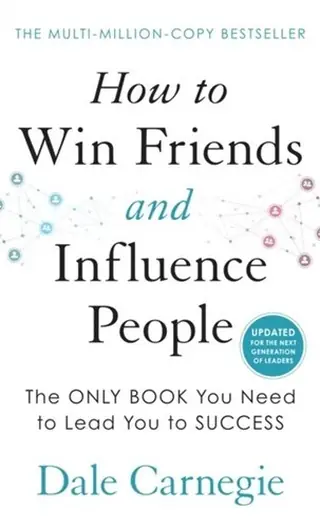
How to Win Friends and Influence People summary
by Dale Carnegie · 1936 · 7 key ideas · 19-minute read
People are driven by pride and feeling, not logic, so the way to influence them is to make them feel genuinely valued and understood.
Why read it
For anyone who wants warmer relationships, smoother work conversations or more persuasive requests. Nearly a century on, it remains the most practical primer on everyday human nature.
How to Win Friends and Influence People in brief
Carnegie starts from a blunt observation: people are not creatures of logic but of emotion, pride and vanity. Almost nobody, however badly they behave, sees themselves as the villain. So criticism rarely changes anyone; it just makes them defensive. If you want to handle people well, you have to work with their deep wish to feel important rather than against it.
From there he offers simple rules for being liked. Be genuinely interested in others, smile, remember names, listen far more than you talk, and speak about what matters to the other person. The person who makes others feel interesting is remembered as delightful company, even if they said very little.
Next he turns to persuasion. Arguments are unwinnable: even if you crush someone's case, you have hurt their pride and they will not change their mind. Instead, show respect for their view, admit your own mistakes quickly, begin in a friendly way, ask questions that lead to agreement, and let them feel the idea is theirs.
Finally he applies all this to leading people. Begin with honest appreciation, point to mistakes indirectly, mention your own errors first, ask rather than order, let people save face, and praise every improvement. Give someone a fine reputation to live up to and they will usually try to deserve it.
Running through every chapter is one condition: sincerity. Carnegie insists that flattery is counterfeit and that these principles only work when you actually care. The book is less a bag of tricks than a sustained argument for treating other people's feelings as the main event.
The 7 key ideas
1. Don't criticize, condemn or complain
Any fool can criticize — and most fools do.
2. Arouse an eager want
Bait the hook with what the fish wants.
3. Become genuinely interested in others
Be interested, not interesting.
4. Names and listening
Their name, their story — make both the centre of the conversation.
5. You can't win an argument
Win the argument, lose the person.
6. Let them own the idea
Plant the question; let them grow the answer.
7. Lead with appreciation and a reputation
Praise the progress you want to see more of.
Read the full guide in Kinquire. Every idea with a real example, a diagram and one thing to try today, plus a quick quiz so it sticks. Free to start.
Read How to Win Friends and Influence PeopleKey takeaways
- Drop criticism and complaint for a week and ask why people act as they do.
- Frame every request around what the other person wants.
- Ask two follow-up questions before talking about yourself.
- Learn and use people's names deliberately.
- Avoid arguments; admit your own mistakes quickly.
- Praise specific improvements and give people a reputation to live up to.
Our take
The book's insight into pride, attention and appreciation has aged remarkably well, and much of it is now supported by research on self-serving bias, listening and liking. Its weaknesses are real, though. The evidence is anecdotal, often from famous businessmen and politicians, and some examples feel dated. Read cynically, the techniques can become manipulation, and the book has little to say about honest disagreement, setting boundaries or confronting genuine wrongdoing. Carnegie's own answer is sincerity, but he can't enforce it. Used with real goodwill, it remains one of the most practical guides to everyday relationships ever written.
About Dale Carnegie
Dale Carnegie was an American writer and teacher of public speaking whose adult-education courses made him famous. This book, drawn from those courses, became one of the best-selling self-help books ever written.
If you liked this
- Influence by Robert B. Cialdini
- Never Split the Difference by Chris Voss
- Just Listen by Mark Goulston
- Supercommunicators by Charles Duhigg
- Crucial Conversations by Kerry Patterson, Joseph Grenny, Ron McMillan and Al Switzler
- Nonviolent Communication by Marshall B. Rosenberg