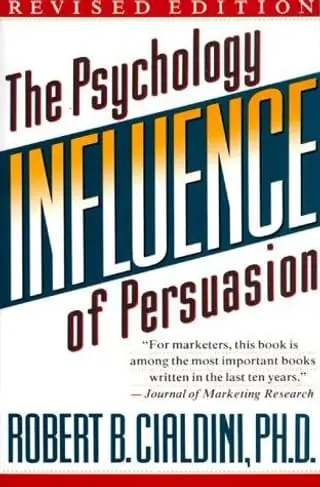
Influence summary
by Robert B. Cialdini · 1984 · 8 key ideas · 21-minute read
Six mental shortcuts — reciprocation, consistency, social proof, liking, authority and scarcity — make us say yes almost automatically, and knowing them lets you use them honestly and resist them when they are used against you.
Why read it
For anyone who sells, leads, negotiates or simply wants to stop being talked into things. It is the founding text of modern persuasion psychology and still the clearest map of why people comply.
Influence in brief
Cialdini begins with a confession: he has always been an easy mark for salespeople and fundraisers. Curious about why, he combined laboratory experiments with years of undercover observation of what he calls compliance professionals — car dealers, charity canvassers, advertisers — to find the principles that reliably produce a yes.
His central insight is that we live in a world too complex to think through every decision, so we rely on shortcuts. Usually these rules of thumb serve us well: return favours, stay consistent, follow the crowd, trust experts, value what is rare. But because they fire automatically, anyone who knows the trigger can set them off, even when the shortcut leads us somewhere we would never choose with full attention.
The book devotes a chapter to each of six principles: reciprocation, commitment and consistency, social proof, liking, authority and scarcity. Each chapter explains the psychology, shows the experiments that demonstrate it, describes how professionals exploit it, and ends with advice on how to say no.
Cialdini is not cynical about influence. These principles are part of healthy social life and can be used honestly. His target is the exploiter who fakes the signals — invented scarcity, counterfeit experts, staged popularity. His defence is simple: learn to notice when a shortcut is being triggered, ask whether the signal is genuine, and if it is not, feel free to step off the automatic path.
The 8 key ideas
1. Click, whirr: we run on autopilot
A reason's shape can persuade even when it has no substance.
2. Contrast changes everything
First the big number, then the small one feels like a bargain.
3. Reciprocation: the debt we can't ignore
A gift with a hook is not a gift — it's a lure.
4. Commitment and consistency
Small yeses build big identities — choose them on purpose.
5. Social proof: following the crowd
A crowd is information, not proof.
6. Liking: we say yes to people we like
Like the person; judge the deal.
7. Authority: obeying the badge
Check the expertise, not the outfit.
8. Scarcity: wanting what we can't have
Rare isn't better — it just feels that way.
Read the full guide in Kinquire. Every idea with a real example, a diagram and one thing to try today, plus a quick quiz so it sticks. Free to start.
Read InfluenceKey takeaways
- When you agree instantly, pause and name the shortcut that was triggered.
- Decide whether a gift attached to a pitch is a tactic; if it is, you owe nothing.
- Before acting on ‘everyone is doing it’, check whether the crowd is really informed and really like you.
- Separate liking the person from evaluating the deal.
- Treat urgency and ‘only a few left’ as a reason to slow down, not speed up.
- Use the principles honestly: give first, point to real evidence, and never fake scarcity or authority.
Our take
Influence holds up remarkably well as a practical map of persuasion, and its six principles have become standard vocabulary in marketing and behavioural science. Its strength is combining experiments with real-world fieldwork. Its limits: some classic studies it leans on, such as Milgram's, have faced methodological criticism; social psychology's replication crisis means effect sizes in the field are often smaller than early studies suggested; and the principles are presented as universal when culture shapes how strongly they apply. Cialdini later added a seventh principle, unity, in Pre-Suasion and in an expanded edition of this book.
About Robert B. Cialdini
Robert Cialdini is a social psychologist and long-time professor at Arizona State University. To research the book he went undercover in sales, fundraising and advertising training programmes to watch professional persuaders at work.
If you liked this
- Pre-Suasion by Robert B. Cialdini
- Thinking, Fast and Slow by Daniel Kahneman
- Nudge by Richard H. Thaler and Cass R. Sunstein
- Made to Stick by Chip Heath and Dan Heath
- How to Win Friends and Influence People by Dale Carnegie
- Crucial Conversations by Kerry Patterson, Joseph Grenny, Ron McMillan and Al Switzler