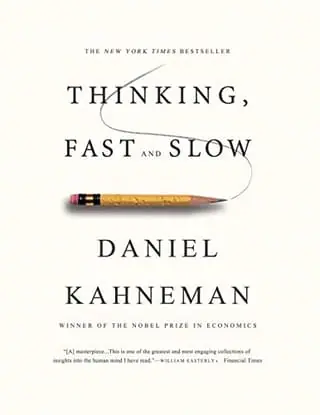
Thinking, Fast and Slow summary
by Daniel Kahneman · 2011 · 8 key ideas · 24-minute read
Your mind runs on a fast, intuitive autopilot and a slow, lazy supervisor, and most of your errors come from trusting the first when you should wake the second.
Why read it
For anyone who makes decisions about money, people or the future. It gives you a vocabulary for spotting your own mental shortcuts before they cost you.
Thinking, Fast and Slow in brief
Kahneman describes the mind as two characters. System 1 is fast, automatic and effortless: it reads faces, finishes phrases and produces gut feelings. System 2 is slow, deliberate and effortful: it does long division and checks arguments. We like to think we are System 2, but System 1 drives most of what we do, and System 2 often just signs off on its suggestions.
System 1 is brilliant at building a coherent story from whatever is in front of it, and blind to what is missing. When a question is hard, it quietly swaps in an easier one and answers that instead. This produces predictable biases: anchoring on irrelevant numbers, judging likelihood by how easily examples come to mind, and seeing causes where there is only chance, as when we miss regression to the mean.
The book then turns to overconfidence. Experts and ordinary people alike trust stories over statistics, plan as if everything will go right, and mistake a feeling of confidence for evidence of accuracy. Kahneman's remedy is to take the outside view: ask how things usually turn out for cases like yours.
Next comes prospect theory, the work that won him the Nobel. People judge outcomes as gains and losses from a reference point, not as final states of wealth, and losses hurt more than equal gains please. That is why framing the same facts differently can flip a decision.
Finally, Kahneman separates the experiencing self, who lives each moment, from the remembering self, who keeps score and makes choices. The remembering self cares about peaks and endings and ignores duration, so we often choose what makes a better memory over what is a better experience.
The 8 key ideas
1. Two systems run your mind
Fast feels right. Slow checks whether it is.
2. What you see is all there is
Confidence measures how neat the story is, not how true.
3. Hard questions get swapped for easy ones
Ask: which question did I actually just answer?
4. Anchors drag your estimates
Whoever names the first number frames the fight.
5. Regression to the mean fools us
After the peak comes the average. It's not your fault, or theirs.
6. Take the outside view
Your plan isn't special. Check the base rate first.
7. Losses loom larger than gains
A loss shouts; an equal gain only whispers.
8. Your remembering self keeps score
Endings write the memory. Design them on purpose.
Read the full guide in Kinquire. Every idea with a real example, a diagram and one thing to try today, plus a quick quiz so it sticks. Free to start.
Read Thinking, Fast and SlowKey takeaways
- When a judgment matters and feels instant, slow down and look for what you might be missing.
- Set your own number before seeing any anchor in a negotiation or purchase.
- Forecast projects from the track record of similar ones, then adjust.
- Before crediting praise or blaming punishment, check whether you are just seeing regression to the mean.
- Reframe big choices as both gains and losses and see if your preference holds.
- Shape the endings of experiences, since they define how they are remembered.
Our take
This is one of the most influential psychology books of its century, and its core ideas about heuristics, overconfidence and prospect theory rest on decades of solid research. Its weaker spots are the social priming studies in the early chapters: several have failed to replicate, and Kahneman later publicly acknowledged he had placed too much faith in underpowered studies. Ego depletion, which he draws on to explain the lazy System 2, is also contested. The book is long and dense, and it is better at diagnosing errors than at curing them; Kahneman himself admits that knowing about biases has done little to remove his own.
About Daniel Kahneman
Daniel Kahneman was a psychologist who shared the 2002 Nobel Memorial Prize in Economic Sciences for his work on judgment and decision-making, much of it done with his long-time collaborator Amos Tversky.
If you liked this
- Noise by Daniel Kahneman, Olivier Sibony and Cass R. Sunstein
- Predictably Irrational by Dan Ariely
- Nudge by Richard H. Thaler and Cass R. Sunstein
- The Happiness Hypothesis by Jonathan Haidt
- Flow by Mihaly Csikszentmihalyi
- Emotional Intelligence by Daniel Goleman