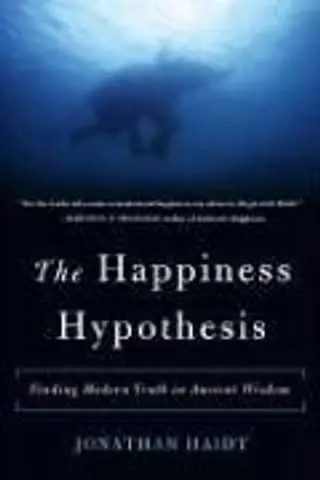
The Happiness Hypothesis summary
by Jonathan Haidt · 2006 · 8 key ideas · 22-minute read
Ancient wisdom about happiness, tested against modern psychology: some of it holds, some needs updating, and the best of it says happiness comes from the right relationships, not from within alone.
Why read it
For anyone curious what Buddha, the Stoics and the Bible got right about the good life, and what science adds. It's a thoughtful, evidence-based tour rather than a quick self-help fix.
The Happiness Hypothesis in brief
Haidt takes ten 'great ideas' from the world's wisdom traditions and asks what modern psychology says about each. He starts with the divided self: the mind is like a rider on an elephant. The rider is conscious reasoning; the elephant is the vast, automatic, emotional rest of us. The rider can guide, but rarely overpower, the elephant.
This explains why changing ourselves is hard and why our minds tilt towards threat and worry. Haidt reviews three tools that genuinely retrain the elephant, namely meditation, cognitive therapy and medication, and then shows how the same automatic processes shape social life: we trade favours, gossip, and judge others harshly while excusing ourselves.
The middle of the book tackles happiness head-on. Each of us has a biological set point, but conditions and voluntary activities matter too. We adapt quickly to most good and bad changes, and we often get more pleasure from progress toward goals than from reaching them. Some conditions, though, are worth changing, and relationships matter most of all.
Haidt then looks at love, adversity, virtue and the sacred. Secure attachment underpins both childhood and adult love; adversity can lead to growth for some people under some conditions; virtue is a skill built through practice; and feelings like elevation and awe point to a dimension of life that pure self-interest misses.
His final answer revises the old hypothesis that happiness comes from within. Happiness, he concludes, comes from between: from getting the right relationships between yourself and others, between yourself and your work, and between yourself and something larger than you. You can't grab it directly, but you can create the conditions for it to grow.
The 8 key ideas
1. The rider and the elephant
Don't argue with the elephant. Change its path.
2. Retrain a mind tilted to worry
You can't order the elephant. You can train it.
3. The mote in your own eye
Look for the plank before pointing at the speck.
4. The happiness formula
You can't change your set point. You can change your days.
5. Progress beats arrival
The summit is a moment. The climb is the life.
6. Love needs secure attachment
Passion lights the fire. Companionship keeps it warm.
7. Adversity can help you grow
Pain plus a story can become growth.
8. Happiness comes from between
Not within, not without: between.
Read the full guide in Kinquire. Every idea with a real example, a diagram and one thing to try today, plus a quick quiz so it sticks. Free to start.
Read The Happiness HypothesisKey takeaways
- Change your environment and habits rather than relying on willpower.
- Use meditation or written thought challenges to retrain worried thinking.
- In any conflict, look for your own share first.
- Fix the life conditions that drain you, especially commute, noise and isolation.
- Choose goals you enjoy pursuing, since progress beats arrival.
- Invest in relationships, meaningful work and something larger than yourself.
Our take
The Happiness Hypothesis is a rare blend of wisdom literature and science, and its central images, the rider and elephant and happiness from between, have lasted. It is careful, humble and well written. Its limits are the limits of mid-2000s psychology: some studies it draws on have since been questioned, set-point and adaptation are now seen as more nuanced, and brain-based explanations are simplified. Its reading of world religions is broad but necessarily selective. Still, as a framework for thinking about the good life, it has aged better than most popular psychology books of its era.
About Jonathan Haidt
Jonathan Haidt is a social psychologist who taught at the University of Virginia and later moved to New York University's Stern School of Business. His other books include The Righteous Mind and The Anxious Generation.
If you liked this
- The Righteous Mind by Jonathan Haidt
- Stumbling on Happiness by Daniel Gilbert
- Flow by Mihaly Csikszentmihalyi
- Thinking, Fast and Slow by Daniel Kahneman
- Predictably Irrational by Dan Ariely
- Emotional Intelligence by Daniel Goleman