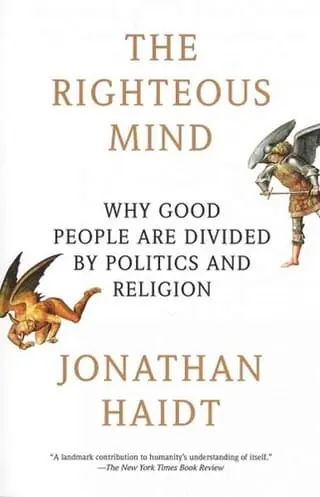
The Righteous Mind summary
by Jonathan Haidt · 2012 · 7 key ideas · 19-minute read
Moral judgments come from fast intuitions that reasoning then defends, and people differ politically because they weigh a different set of moral intuitions.
Why read it
For anyone baffled or frustrated by people on the other side of politics or religion. It explains why good people disagree so fiercely and how to have better conversations across the divide.
The Righteous Mind in brief
Haidt asks why it is so hard for people to get along across political and religious lines. His answer comes in three principles, each taking up one part of the book. The first is that intuitions come first and strategic reasoning second. We feel a moral verdict almost instantly, then our reasoning works like a lawyer or press secretary, building a case for what we already believe.
The second principle is that there's more to morality than harm and fairness. Drawing on cross-cultural research and his time studying morality in India, Haidt and colleagues propose a set of moral foundations: care, fairness, loyalty, authority, sanctity and, later, liberty. Western educated liberals tend to build their morality mostly on care and fairness, while conservatives draw more evenly on all of them.
The third principle is that morality binds and blinds. Humans are, in Haidt's phrase, 90 percent chimp and 10 percent bee: mostly selfish, but capable of losing ourselves in a group. Religion, rituals and shared sacred values bind teams together, which helped our ancestors cooperate, but the same binding makes us blind to the other side's point of view.
The book closes with a plea for humility. Each side of politics sees some moral truths more clearly than the other. If we understand that our opponents are guided by real moral concerns rather than stupidity or malice, we can talk to them more productively and design institutions that use the strengths of both.
The 7 key ideas
1. The elephant and the rider
Talk to the elephant first. The rider follows.
2. Reason as press secretary
We reason to win, unless someone makes us reason to learn.
3. The moral taste buds
Six taste buds. Every culture cooks a different moral meal.
4. Why liberals and conservatives talk past each other
Same tongue, different taste. Translate before you argue.
5. Ninety percent chimp, ten percent bee
We're selfish, but we can become a hive.
6. Morality binds and blinds
What we hold sacred, we stop seeing clearly.
7. Disagree more productively
Win the relationship before you try to win the argument.
Read the full guide in Kinquire. Every idea with a real example, a diagram and one thing to try today, plus a quick quiz so it sticks. Free to start.
Read The Righteous MindKey takeaways
- Notice your gut verdict first, then question whether your reasons came before or after it.
- When persuading, appeal to feelings and relationships before facts and logic.
- Identify which moral foundations are driving the other person's view.
- Seek out people who disagree with you to check your own reasoning.
- Look for at least one truth the other side sees more clearly than yours.
Our take
The Righteous Mind is one of the most influential books on political psychology, and its picture of intuition-first reasoning is well supported by research. The moral foundations themselves are more contested: critics question the measurement, the number of foundations and whether harm is more central than Haidt allows. His embrace of group selection divides biologists. Some readers on the left felt he was too generous to conservatives; some on the right felt he still saw them as a curiosity. Its call for humility across divides remains valuable.
About Jonathan Haidt
Jonathan Haidt is an American social psychologist who taught for many years at the University of Virginia and is now at New York University's Stern School of Business. He is known for research on moral psychology and moral foundations theory.
If you liked this
- The Happiness Hypothesis by Jonathan Haidt
- Thinking, Fast and Slow by Daniel Kahneman
- The Coddling of the American Mind by Greg Lukianoff and Jonathan Haidt
- Factfulness by Hans Rosling with Ola Rosling and Anna Rosling Rönnlund
- The Anxious Generation by Jonathan Haidt
- Outliers by Malcolm Gladwell