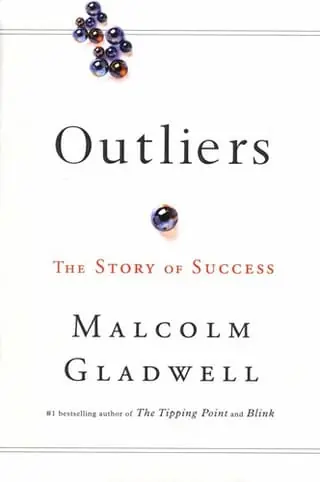
Outliers summary
by Malcolm Gladwell · 2008 · 7 key ideas · 19-minute read
Extraordinary success is not just the product of individual talent but of hidden advantages, timing, practice opportunities and cultural legacies.
Why read it
For anyone who believes success is purely about grit and genius. It changes how you see achievement, and how you might widen opportunity for others.
Outliers in brief
Gladwell sets out to challenge the self-made myth. We usually explain the success of top athletes, entrepreneurs and lawyers by their personal qualities. He argues that we should look instead at where they came from: when they were born, what opportunities fell into their laps, and what cultural habits they inherited.
The first part is about opportunity. Small early advantages, like being the oldest in a sports age group, compound over time. Mastery requires a huge amount of practice, often given as roughly 10,000 hours, and the people who reach it usually had unusual chances to put in those hours. Birth year matters too: many tech pioneers were born in a narrow window that made them the right age when personal computing took off.
Gladwell then argues that intelligence beyond a certain threshold matters less than we think. What separates people after that point is practical intelligence, like knowing how to negotiate with teachers, bosses and officials, and he argues this is often learned at home, so it depends heavily on a family's class.
The second part is about legacy. Cultural habits passed down through generations, from a culture of honour to attitudes toward authority and hard work, shape how people behave. Gladwell uses examples from feuding families in Kentucky, airline cockpits and rice farming. He ends by arguing that if success depends on such patterns, we can deliberately build more of them for more people.
The 7 key ideas
1. Accumulative advantage
Early luck, mistaken for talent, becomes real talent.
2. The 10,000-hour rule
Talent needs hours, and hours need opportunity.
3. The right time to be born
Talent meets timing. Neither works alone.
4. Smart enough is enough
Being smart opens the door. Knowing how to ask walks you through.
5. Cultural legacies
We inherit habits along with surnames.
6. Power distance in the cockpit
A hint is not a warning. Say it plainly.
7. Rice paddies and hard work
Persistence is cultural, which means it can be learned.
Read the full guide in Kinquire. Every idea with a real example, a diagram and one thing to try today, plus a quick quiz so it sticks. Free to start.
Read OutliersKey takeaways
- When you see success, ask what hidden advantages and timing helped produce it.
- Seek out environments that give you many hours of practice with feedback.
- Look for arbitrary cutoffs in your organisation that may favour some people unfairly.
- Speak up plainly when you see a problem, especially to someone senior.
- Remember that opportunity can be deliberately designed and shared.
Our take
Outliers made a powerful case that success is shaped by opportunity, timing and culture, and the relative-age effect in particular is well documented. But Gladwell's method is storytelling: he picks vivid cases that fit his argument and rarely weighs counter-examples. The 10,000-hour rule was oversimplified, according to the researcher whose work inspired it. The Korean Air and rice-paddy chapters have been criticised as cultural generalisation. Read it for its important central insight and its memorable stories, but treat the specific claims as hypotheses rather than settled facts.
About Malcolm Gladwell
Malcolm Gladwell is a Canadian journalist and longtime staff writer for The New Yorker. He is also the author of The Tipping Point and Blink and hosts the podcast Revisionist History.
If you liked this
- Range by David Epstein
- David and Goliath by Malcolm Gladwell
- Factfulness by Hans Rosling with Ola Rosling and Anna Rosling Rönnlund
- The Righteous Mind by Jonathan Haidt
- The Anxious Generation by Jonathan Haidt
- Humankind by Rutger Bregman