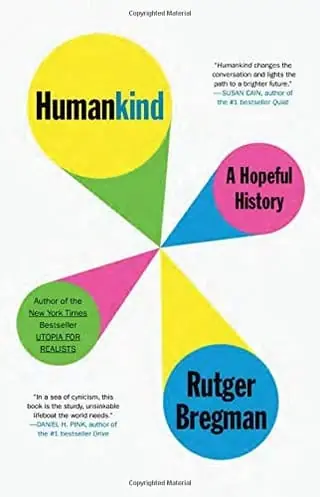
Humankind summary
by Rutger Bregman · 2019 · 7 key ideas · 17-minute read
Most people are, deep down, pretty decent, and believing otherwise leads us to build institutions that bring out the worst in us.
Why read it
For anyone who has grown cynical about human nature. It challenges famous experiments and stories that taught us people are selfish, and offers a more hopeful but still realistic way to live and lead.
Humankind in brief
Bregman sets out a radical idea: that most people, most of the time, are fundamentally decent. He traces the opposite view, that civilisation is a thin veneer over our selfish instincts, through thinkers like Thomas Hobbes, and argues that it has shaped how we design schools, prisons, workplaces and politics.
He revisits evidence for the cynical view. Famous stories, like the novel Lord of the Flies and the collapse of Easter Island, and famous experiments, such as the Stanford Prison Experiment and the Kitty Genovese case, are re-examined. In many, Bregman argues, the reality was more complicated, or more hopeful, than the textbook version.
He then offers an alternative account of human evolution, in which we became 'Homo puppy', a species that thrived because it was friendly and good at cooperating. But our sociability has a dark side: we are kind to our in-group and can be cruel to strangers, especially when leaders and ideologies dehumanise them.
Finally, Bregman describes institutions built on trust, from self-managed nursing teams to open prisons and participatory budgeting, and argues they work better than cynics expect. He ends with practical rules for living that start from the assumption that others mean well.
The 7 key ideas
1. Veneer theory is wrong
Assume the veneer is thicker than you think.
2. The real Lord of the Flies
Fiction made us cynical. Real boys made a garden.
3. Famous experiments, revisited
Famous isn't the same as true.
4. Homo puppy
Survival of the friendliest.
5. Empathy's dark side
Empathy is a spotlight. Compassion is daylight.
6. Build institutions on trust
Treat people like adults and most will act like adults.
7. Ten rules for a new realism
Assume the best. You'll be right more often than wrong.
Read the full guide in Kinquire. Every idea with a real example, a diagram and one thing to try today, plus a quick quiz so it sticks. Free to start.
Read HumankindKey takeaways
- When in doubt about someone's motives, start by assuming the best.
- Be sceptical of 'proofs' that people are bad, and check where they come from.
- Give people responsibility and trust, then see how they respond.
- Spend time with people from groups you rarely meet.
- Cut back on news that trains you to see the worst in people.
Our take
Humankind is a stirring corrective to cynicism and a useful reminder that famous studies are not always what they seem. Its debunkings of the Stanford Prison Experiment and the Genovese myth rest on solid later reporting. But critics note that Bregman is far more sceptical of studies that show cruelty than of those that show kindness, that he sometimes picks inspiring examples without weighing failures, and that human nature is more mixed than either the cynics or he suggest. Read it as a strong argument for one side of an old debate, not the final word.
About Rutger Bregman
Rutger Bregman is a Dutch historian and writer, previously known for Utopia for Realists, which argued for ideas such as universal basic income and a shorter working week.
If you liked this
- The Better Angels of Our Nature by Steven Pinker
- Factfulness by Hans Rosling with Ola Rosling and Anna Rosling Rönnlund
- The Righteous Mind by Jonathan Haidt
- The Anxious Generation by Jonathan Haidt
- Outliers by Malcolm Gladwell
- David and Goliath by Malcolm Gladwell