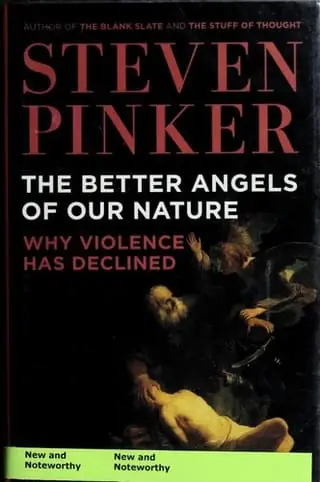
The Better Angels of Our Nature summary
by Steven Pinker · 2011 · 7 key ideas · 18-minute read
Violence of almost every kind has declined over the long sweep of history, because forces like states, trade, literacy and reason have increasingly favoured our peaceable instincts over our violent ones.
Why read it
For anyone who assumes the modern world is uniquely violent. It is a vast, data-heavy argument that changes how you see history, even if you end up disagreeing with parts of it.
The Better Angels of Our Nature in brief
Pinker makes a bold claim: violence has declined over long stretches of time, and today we may be living in the most peaceful era in our species' existence. He means violence measured relative to population, the chance that any given person will die violently, and he covers everything from tribal warfare and homicide to torture, slavery, war and the abuse of children and animals.
He organises the decline into six major trends: the pacification process, as states emerged; the civilising process in early modern Europe; the humanitarian revolution of the Enlightenment; the long peace among great powers after 1945; the new peace after the Cold War; and the rights revolutions of recent decades.
To explain why, he turns to psychology. Humans have inner demons, motives like predation, dominance, revenge, sadism and ideology that can lead to violence, and better angels, faculties like empathy, self-control, a moral sense and reason that can steer us away from it.
Finally he identifies five historical forces that tipped the balance toward our better angels: the state's monopoly on force, trade, the growing influence of women, cosmopolitanism through literacy and travel, and the escalator of reason. He insists the decline isn't guaranteed and could be reversed, but argues it is real and worth understanding.
The 7 key ideas
1. Measure violence by rates
Count the risk to each person, not just the total.
2. The pacifying power of the state
A referee ends the feud.
3. The civilising process
Trade and manners made strangers worth keeping alive.
4. The humanitarian revolution
Reading widens the circle of who counts.
5. The long peace
Trade, democracy and institutions make war costly.
6. Inner demons
Name the demon and you weaken its grip.
7. Better angels and historical forces
Feed the angels. Starve the demons.
Read the full guide in Kinquire. Every idea with a real example, a diagram and one thing to try today, plus a quick quiz so it sticks. Free to start.
Read The Better Angels of Our NatureKey takeaways
- Compare violence across time as a rate per person, not raw totals.
- Support institutions that punish aggression fairly and remove the need for revenge.
- Value trade and cooperation as forces that make peace profitable.
- Widen your circle of empathy through reading and travel.
- Name your aggressive impulses so reason can step in.
Our take
The Better Angels of Our Nature is a monumental synthesis, and its core claim that many forms of violence have declined is widely accepted for homicide, torture and cruel punishment. Its most contested claims concern prehistoric violence, where anthropologists dispute the data, and war, where critics such as Nassim Taleb argue that the long peace may be statistically fragile. Others say it is Eurocentric or gives too much credit to the Enlightenment. Pinker has responded to many critics and insists the decline is not inevitable. Read it alongside its critics.
About Steven Pinker
Steven Pinker is a Canadian-born cognitive psychologist at Harvard University, known for books on language and the mind such as The Language Instinct and How the Mind Works.
If you liked this
- Enlightenment Now by Steven Pinker
- Humankind by Rutger Bregman
- Factfulness by Hans Rosling with Ola Rosling and Anna Rosling Rönnlund
- The Righteous Mind by Jonathan Haidt
- The Anxious Generation by Jonathan Haidt
- Outliers by Malcolm Gladwell