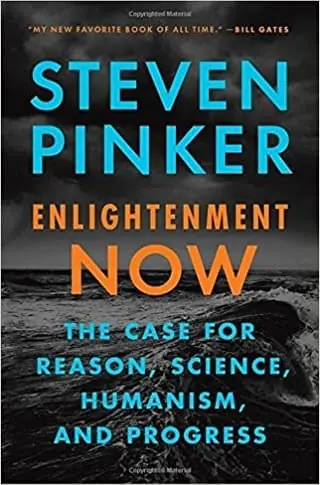
Enlightenment Now summary
by Steven Pinker · 2018 · 7 key ideas · 18-minute read
By almost every measure, human life has improved enormously, and the ideals of the Enlightenment, reason, science and humanism, deserve the credit and our defence.
Why read it
For anyone who feels the world is going to ruin. It gives you data on long-term progress and a strong, if contested, argument for the values that produced it.
Enlightenment Now in brief
Pinker argues that the Enlightenment ideals of reason, science, humanism and progress are under-appreciated and under attack, from religious and nationalist movements on one side and from intellectuals who scorn the idea of progress on the other. He sets out to defend them with data.
The book's middle section presents chapter after chapter of evidence that human life has improved: people live much longer, fewer children die, famine has receded, extreme poverty has fallen dramatically, violence and war deaths have declined, democracy and rights have spread, and people are better educated and have more leisure.
He explains why we fail to see this progress. Negative events are sudden and newsworthy, while positive trends are gradual and rarely reported. Our minds overweight vivid examples and losses. And intellectuals, he argues, often treat pessimism as a sign of sophistication and optimism as naive.
Pinker does not say everything is fine. He discusses problems like climate change and nuclear weapons, and argues they too are best solved through science, technology and cooperation. The final part defends reason, science and humanism against their critics, arguing they remain the best tools we have for improving human lives.
The 7 key ideas
1. Progress is real, and big
Zoom out. Progress hides in the long view.
2. Why progress is invisible
If it bleeds, it leads. If it improves, it vanishes.
3. Entropy, evolution, information
Disorder is free. Order takes work.
4. Inequality isn't poverty
Ask whether people have enough, not only who has more.
5. Ecomodernism
Problems are inevitable. Problems are solvable.
6. Reason, science and humanism
Reason isn't a mood. It's a method for fixing mistakes.
7. Conditional optimism
Not inevitable. Possible, if we keep working.
Read the full guide in Kinquire. Every idea with a real example, a diagram and one thing to try today, plus a quick quiz so it sticks. Free to start.
Read Enlightenment NowKey takeaways
- Judge trends by long-run data, not by the latest headlines.
- Treat pessimism and optimism as claims to test, not attitudes to adopt.
- Separate the question of poverty from the question of inequality.
- See environmental and other threats as serious but solvable problems.
- Defend institutions that correct errors: science, free speech and open debate.
Our take
Enlightenment Now marshals impressive data showing long-run gains in health, wealth and safety, and most of its trends are uncontested. Its critics focus on interpretation. Historians argue that it simplifies the Enlightenment and gives it credit for progress with many causes. Some economists think it downplays inequality; environmentalists say it underrates ecological risk; and some readers find its dismissal of critics of progress too sweeping. Others see it as a needed antidote to fashionable pessimism. Its data is a valuable starting point, even for readers who reject its conclusions.
About Steven Pinker
Steven Pinker is a Canadian-born cognitive psychologist and professor at Harvard University. He is known for books including The Language Instinct, How the Mind Works and The Better Angels of Our Nature.
If you liked this
- The Better Angels of Our Nature by Steven Pinker
- Factfulness by Hans Rosling with Ola Rosling and Anna Rosling Rönnlund
- The Righteous Mind by Jonathan Haidt
- The Anxious Generation by Jonathan Haidt
- Outliers by Malcolm Gladwell
- David and Goliath by Malcolm Gladwell