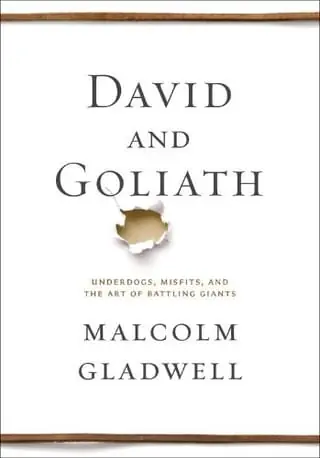
David and Goliath summary
by Malcolm Gladwell · 2013 · 7 key ideas · 18-minute read
Apparent advantages often carry hidden weaknesses, and apparent disadvantages can become sources of strength.
Why read it
For anyone facing a bigger rival, a setback or a hard start in life. It reframes what counts as strength and offers useful mental tools, if you read its stories with some scepticism.
David and Goliath in brief
Gladwell retells the biblical battle between the shepherd David and the giant Goliath. We treat it as the story of an unlikely win, but Gladwell argues David's victory was not so surprising. A slinger with a stone was a deadly ranged fighter, and Goliath, heavily armoured and possibly ill, was built for close combat David refused to give him.
The first part of the book explores the advantages of disadvantages. Underdogs who refuse to play by the giant's rules win more often than we'd expect. More resources help only up to a point: beyond it, they can hurt, as with very small class sizes or very prestigious universities where good students feel like failures.
The second part looks at desirable difficulties. Some hardships, like dyslexia or losing a parent young, can force people to develop unusual skills, such as exceptional listening or a high tolerance for risk. Gladwell stresses, though, that for many people such hardships are simply damaging, and that the benefit depends on how someone responds.
The third part is about the limits of power. Authorities that are seen as unfair provoke resistance rather than obedience. Gladwell argues that legitimacy, meaning fairness, a voice for those affected and consistency, matters more than force. He ends with communities that used moral strength to resist much stronger opponents.
The 7 key ideas
1. Goliath's hidden weakness
Every giant is strong somewhere and slow somewhere.
2. Don't play the giant's game
If you can't win their game, change the game.
3. The inverted U
More is better, until it isn't.
4. Big fish, little pond
You compare yourself with your pond, not the ocean.
5. Desirable difficulties
It's not the difficulty, it's what you build around it.
6. The limits of power
Power without fairness creates enemies.
7. The strength of the weak
Those with nothing left to lose are hard to scare.
Read the full guide in Kinquire. Every idea with a real example, a diagram and one thing to try today, plus a quick quiz so it sticks. Free to start.
Read David and GoliathKey takeaways
- When facing a stronger rival, look for the weakness built into their strength.
- Consider unconventional strategies that the powerful would consider beneath them.
- Ask whether more resources will truly help or whether you're past the sweet spot.
- Choose environments where you can stay motivated, not just the most prestigious.
- If you hold authority, earn legitimacy through voice, consistency and fairness.
Our take
David and Goliath offers memorable reframes: strengths hide weaknesses, more isn't always better and legitimacy matters more than force. Its weakness is method. Gladwell builds big claims on a handful of stories and selected studies, and reviewers, including the psychologist Christopher Chabris, criticised him for overstating evidence and ignoring counter-examples, for instance on class sizes and the value of selective universities. The dyslexia chapter was accused of romanticising hardship, despite his caveats. Treat it as a source of useful questions rather than settled answers.
About Malcolm Gladwell
Malcolm Gladwell is a Canadian journalist and staff writer for The New Yorker, and the author of The Tipping Point, Blink and Outliers.
If you liked this
- Outliers by Malcolm Gladwell
- Antifragile by Nassim Nicholas Taleb
- Talking to Strangers by Malcolm Gladwell
- The Art of War by Sun Tzu
- Factfulness by Hans Rosling with Ola Rosling and Anna Rosling Rönnlund
- The Righteous Mind by Jonathan Haidt