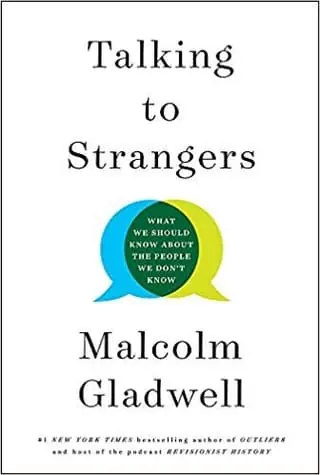
Talking to Strangers summary
by Malcolm Gladwell · 2019 · 7 key ideas · 17-minute read
We are bad at understanding strangers because we assume they're honest, assume their faces reveal their feelings and ignore the context that shapes their behaviour.
Why read it
For anyone who has misjudged a person or been fooled. It offers humbling lessons about trust, deception and the limits of reading people, set against real cases from spying to policing.
Talking to Strangers in brief
Gladwell frames the book around the 2015 death of Sandra Bland, a young Black woman who was pulled over by a Texas police officer for failing to signal a lane change. The stop escalated into an arrest, and three days later she died by suicide in a jail cell. He asks how an ordinary encounter between strangers could go so wrong.
His answer is that we rely on flawed strategies when dealing with people we don't know. First, we default to truth: we assume people are honest unless the evidence of lying becomes overwhelming. Second, we assume transparency: that people's behaviour and facial expressions reveal what they feel. Both lead us astray, especially with people whose behaviour doesn't match their inner state.
Third, we neglect coupling: the way behaviour is tied to particular places and contexts. He shows this through suicide rates that fell when a common method disappeared, and through crime concentrated in a few streets. When we ignore context, we blame individuals for what their circumstances made likely.
Gladwell returns to Sandra Bland to show all three errors at work: an officer trained to be suspicious, a misreading of her behaviour, and a policing strategy applied far beyond the places where it made sense. His conclusion is that we must accept the limits of our ability to know strangers, and act with humility and restraint.
The 7 key ideas
1. Default to truth
Trust is the default. That's both the gift and the risk.
2. The price of the holy fool
Society needs a few sceptics, not a nation of them.
3. The transparency myth
Faces don't come with subtitles.
4. Meeting someone can make it worse
A handshake feels like knowledge. Often it isn't.
5. Coupling
Change the context and you change the behaviour.
6. Crime clusters, and so should policing
Right tool, right place. Everywhere is nowhere.
7. Humility with strangers
When in doubt about a stranger, ask, don't assume.
Read the full guide in Kinquire. Every idea with a real example, a diagram and one thing to try today, plus a quick quiz so it sticks. Free to start.
Read Talking to StrangersKey takeaways
- Remember that you're only slightly better than chance at spotting lies.
- Don't treat someone's demeanour as proof of guilt or innocence.
- Give more weight to records and evidence than to first impressions.
- Look for the context a behaviour is coupled to before blaming the person.
- Approach strangers with humility and ask before assuming.
Our take
Talking to Strangers raises important questions about trust and misjudgment, and draws on real research such as Tim Levine's truth-default theory and work on crime concentration. But critics argue its cases are loosely connected and that Gladwell stretches each theory to fit his narratives. His treatment of Sandra Bland's death, in particular, was criticised for downplaying the role of race and police power in favour of general psychology. Some also found the mix of cases, from spies to sexual assault to suicide, uneasy. Read it for its useful concepts, not as a complete explanation.
About Malcolm Gladwell
Malcolm Gladwell is a Canadian journalist and staff writer for The New Yorker, and the author of The Tipping Point, Outliers and David and Goliath.
If you liked this
- Blink by Malcolm Gladwell
- Outliers by Malcolm Gladwell
- Thinking, Fast and Slow by Daniel Kahneman
- Factfulness by Hans Rosling with Ola Rosling and Anna Rosling Rönnlund
- The Righteous Mind by Jonathan Haidt
- The Anxious Generation by Jonathan Haidt