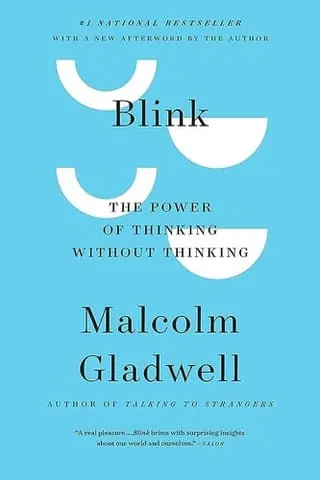
Blink summary
by Malcolm Gladwell · 2005 · 7 key ideas · 19-minute read
Snap judgments made in the first two seconds can be astonishingly accurate or dangerously wrong, and we can learn when to trust them and how to train them.
Why read it
For anyone who wonders whether to trust their gut. Through vivid stories, it shows when quick judgments beat careful analysis, when they mislead us, and how to improve them.
Blink in brief
Gladwell's subject is the first two seconds: the rapid, unconscious judgments we make before we've had time to think. He argues that these snap judgments, produced by what psychologists call the adaptive unconscious, can be remarkably accurate, sometimes more accurate than slow, deliberate analysis.
The key skill is thin-slicing: finding patterns in a narrow slice of experience. Experts in art, marriage, sport and medicine can read a situation in seconds because their unconscious has learned which cues matter. Often, though, they can't explain how they know, and asking them to explain can make their judgments worse.
But snap judgments can also go badly wrong. Our unconscious absorbs stereotypes and associations we don't consciously endorse, leading us to favour tall, good-looking or familiar people. Under extreme stress, our ability to read others can collapse entirely, with tragic results.
Gladwell's remedy isn't to abandon intuition but to manage it. Give experts less information, not more, so they can focus on what matters. Create structures and training that let quick thinking work well under pressure. And change the environment so that biased first impressions can't take hold of important decisions in the first place.
His examples are deliberately wide-ranging: an ancient statue that experts doubted at a glance, couples observed in a marriage lab, a military war game, a chest-pain rule in a Chicago emergency room, cola taste tests, a fatal police shooting in New York and orchestra auditions held behind a screen. Together they show the power and the danger of the first two seconds.
The 7 key ideas
1. Thin-slicing
Experts see in seconds what took them years to learn.
2. We know more than we can say
A hunch can be right even without a reason.
3. The Warren Harding error
Looking the part isn't playing the part.
4. Less information, better decisions
Find the few signals. Ignore the noise.
5. Structure makes spontaneity work
Practise hard so you can improvise easily.
6. Stress shuts down mind-reading
Slow the moment down, and you can read it.
7. Change the conditions, not just minds
If you can't unsee it, hide it.
Read the full guide in Kinquire. Every idea with a real example, a diagram and one thing to try today, plus a quick quiz so it sticks. Free to start.
Read BlinkKey takeaways
- Trust expert intuition mainly where feedback is fast and clear.
- Don't force a gut feeling into a neat story; test it instead.
- Check whether looks, height or background are shaping your judgments of people.
- Base decisions on the few factors that matter most, not on more data.
- Slow down heated moments to keep your judgment working.
- Remove irrelevant cues from important decisions.
Our take
Blink is gripping storytelling and introduced millions of readers to research on intuition, thin-slicing and implicit bias. But it is better at stories than at telling you when to trust your gut: it shows intuition succeeding and failing without a clear rule for which is which. Later work by Kahneman and Klein offers that rule: trust intuition in predictable environments with fast feedback. Several studies Gladwell relies on, including some on priming and the IAT, have since faced replication or validity problems, and Gottman's prediction claims have been criticised. Treat it as an engaging introduction rather than a reliable guide.
About Malcolm Gladwell
Malcolm Gladwell has been a staff writer at The New Yorker since 1996. His other books include The Tipping Point and Outliers.
If you liked this
- Thinking, Fast and Slow by Daniel Kahneman
- Noise by Daniel Kahneman, Olivier Sibony and Cass R. Sunstein
- The Tipping Point by Malcolm Gladwell
- Predictably Irrational by Dan Ariely
- The Happiness Hypothesis by Jonathan Haidt
- Flow by Mihaly Csikszentmihalyi