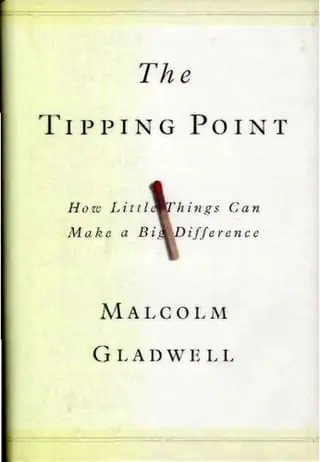
The Tipping Point summary
by Malcolm Gladwell · 2000 · 7 key ideas · 18-minute read
Ideas, products and behaviours spread like epidemics, and they tip when the right few people, a sticky message and the right context come together.
Why read it
For anyone who wants to start a movement, launch a product or change behaviour. It's a lively, story-driven introduction to social contagion — best read alongside the later research that has challenged parts of it.
The Tipping Point in brief
Why do some trends suddenly explode — a forgotten shoe brand becoming fashionable, crime falling sharply in a city, a children's TV show catching on? Malcolm Gladwell argues that ideas and behaviours spread like epidemics: they're contagious, small causes can have big effects, and change can happen not gradually but at one dramatic moment, the tipping point.
He proposes three rules that govern these epidemics. The Law of the Few says a small number of exceptional people — Connectors, Mavens and Salesmen — drive most of the spread. The Stickiness Factor says the message itself must be memorable enough to change behaviour. The Power of Context says people are far more sensitive to their environment than we assume.
Gladwell illustrates these with memorable stories: Paul Revere's midnight ride, the making of Sesame Street and Blue's Clues, New York's subway graffiti clean-up, and a company that capped its buildings at 150 people. The rules, he suggests, can help explain why some things take off and others don't.
His optimistic conclusion is that change is possible with limited resources. By concentrating on the right people, tweaking the message and adjusting the context, a small, well-placed push can tip an idea into an epidemic. It's an appealing message for anyone who feels their resources are too small to matter.
The 7 key ideas
1. Ideas spread like epidemics
Small causes, sudden effects.
2. Connectors: people who know everyone
It matters who carries the message.
3. Mavens and Salesmen
Mavens know, Connectors share, Salesmen persuade.
4. The Stickiness Factor
Tweak the packaging, not just the message.
5. The Power of Context
Change the room, change the behaviour.
6. The Rule of 150
Keep it small enough to know each other.
7. Focus your push
Not more effort — better-aimed effort.
Read the full guide in Kinquire. Every idea with a real example, a diagram and one thing to try today, plus a quick quiz so it sticks. Free to start.
Read The Tipping PointKey takeaways
- Identify the Connectors, Mavens and Salesmen in your network.
- Test small changes in how your message is presented to make it stick.
- Change the environment, not just the arguments, to shift behaviour.
- Keep groups small enough that people genuinely know each other.
- Concentrate limited resources where a push will have the biggest effect.
Our take
The Tipping Point is a brilliant piece of storytelling that made concepts like social contagion and viral spread part of everyday language. Its framework is memorable and its stories are vivid. But its evidence is often anecdotal and selected after the fact. The Law of the Few has been challenged by network research suggesting influencers matter less than the overall susceptibility of a network. Broken windows policing remains contested and controversial. Dunbar's number is debated. Read it as an inspiring set of hypotheses about how change spreads, not as settled science.
About Malcolm Gladwell
Malcolm Gladwell is a staff writer at The New Yorker and the author of Blink, Outliers and other bestsellers. He returned to this book's themes in Revenge of the Tipping Point (2024).
If you liked this
- Contagious by Jonah Berger
- Made to Stick by Chip Heath and Dan Heath
- Zero to One by Peter Thiel with Blake Masters
- The Lean Startup by Eric Ries
- The Hard Thing About Hard Things by Ben Horowitz
- The E-Myth Revisited by Michael E. Gerber