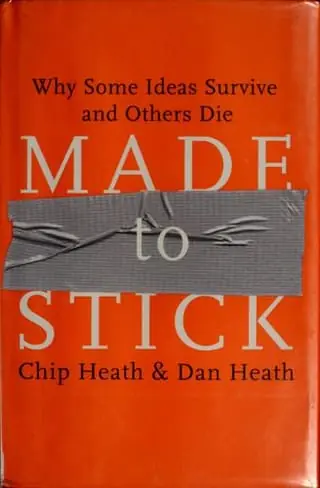
Made to Stick summary
by Chip Heath and Dan Heath · 2007 · 7 key ideas · 18-minute read
Ideas that people remember and act on share six traits — simple, unexpected, concrete, credible, emotional and story-shaped — and you can build them in on purpose.
Why read it
For anyone who has to explain something and have it stick: teachers, managers, founders, marketers, doctors. It turns a vague talent for “good communication” into a checklist you can actually use.
Made to Stick in brief
Why do urban legends and proverbs survive for centuries while carefully crafted mission statements are forgotten by lunchtime? The Heath brothers argue that sticky ideas are not a matter of luck or genius. They share a recognisable set of traits, and those traits can be learned and deliberately built into any message.
The main villain is the Curse of Knowledge. Once we know something well, we can no longer imagine what it is like not to know it, so we speak in abstractions that feel meaningful to us and mean nothing to our audience. Experts, executives and teachers suffer from it most.
The cure is a checklist the authors spell out as SUCCESs: Simple (find the core and say it compactly), Unexpected (break a pattern to win attention, then open a curiosity gap to hold it), Concrete (use sensory, specific language), Credible (let people test the claim for themselves), Emotional (make people care, usually about one person rather than a crowd) and Stories (give people a mental simulation they can rehearse).
The book is built from vivid cases: a newspaper lead that said only that there would be no school next Thursday, a cinema popcorn exposé, an airline that asks whether a menu change makes it the low-fare airline. The message throughout is that you don't need to be a born communicator. You need to spot your own curse of knowledge and run your idea through the six principles before you send it.
The 7 key ideas
1. Beware the Curse of Knowledge
You hear the melody. They only hear the tapping.
2. Simple: find the core
If you say three things, you don't say anything.
3. Unexpected: break a pattern, open a gap
Surprise gets attention. Curiosity keeps it.
4. Concrete: make it something you can see
If you can't picture it, they can't remember it.
5. Credible: let them test it
Don't ask them to trust you — let them check.
6. Emotional: one person beats a million
Statistics inform. A single face moves.
7. Stories: flight simulators for the mind
Don't invent stories — collect them.
Read the full guide in Kinquire. Every idea with a real example, a diagram and one thing to try today, plus a quick quiz so it sticks. Free to start.
Read Made to StickKey takeaways
- Test every important message on an outsider to expose your curse of knowledge.
- Write a one-sentence Commander's Intent before you write anything else.
- Open with the assumption you're about to break, then hold attention with a question.
- Replace abstractions with something people could see or count.
- Use one person's story, and let numbers support it rather than lead.
- Keep a file of real stories that carry your core message.
Our take
Made to Stick is one of the most practical books on communication: the SUCCESs checklist is easy to remember and genuinely improves talks, emails and campaigns. Its weakness is that it mostly analyses ideas that already stuck, so it can't show how many messages ticked every box and still flopped; luck, timing and distribution matter more than the book admits. Some of the research it draws on, such as work on emotion and giving, is more nuanced than a single anecdote suggests. Still, as a tool for fighting your own curse of knowledge, it has aged very well.
About Chip Heath and Dan Heath
Chip Heath is a professor at Stanford's Graduate School of Business; his brother Dan Heath has worked as a senior fellow at Duke University's CASE center. Together they also wrote Switch and Decisive.
If you liked this
- Contagious by Jonah Berger
- Influence by Robert B. Cialdini
- Zero to One by Peter Thiel with Blake Masters
- The Lean Startup by Eric Ries
- The Hard Thing About Hard Things by Ben Horowitz
- The E-Myth Revisited by Michael E. Gerber