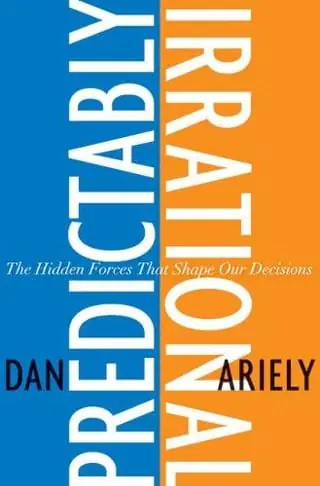
Predictably Irrational summary
by Dan Ariely · 2008 · 8 key ideas · 21-minute read
Our mistakes with money, choices and self-control aren't random; they follow patterns, and once you see the patterns you can design around them.
Why read it
For anyone who buys, sells, negotiates or struggles with willpower. Short, playful experiments reveal why price tags, 'free' offers and deadlines move us more than we'd like.
Predictably Irrational in brief
Standard economics assumes people weigh costs and benefits sensibly and act in their own best interest. Ariely argues that we are irrational, but not randomly so: we make the same mistakes again and again, in ways that can be predicted. He shows it through a string of clever, often playful experiments, many run with students at MIT and elsewhere.
The first theme is that we judge value by comparison, not in absolute terms. Decoy options, first prices we happen to see and the magic word 'free' all steer choices that should depend only on what we actually want. Once an arbitrary price is in our heads, it shapes what we're willing to pay for years.
The second theme is that social and emotional forces outweigh tidy calculation. People happily help for nothing but resent being underpaid, value what they own far above its market price, and chase options they will never use simply to avoid losing them.
The third theme is self-control and expectation. We know we'll procrastinate yet rarely protect ourselves from it, and what we expect (from a price, a brand or a label) changes what we actually experience. A drink tastes worse if we're told about an odd ingredient first, and a pill described as expensive relieves more pain than the same pill sold cheaply.
Ariely's message is ultimately hopeful. Because these errors are systematic rather than random, we can anticipate them and build tools, rules and policies that work with human nature instead of against it, from self-imposed deadlines and automatic savings to clearer pricing and smarter workplace incentives.
The 8 key ideas
1. Everything is relative
The option you'll never pick is choosing for you.
2. Arbitrary anchors stick
First price in, last price out.
3. Free is a different kind of price
Free isn't nothing. It's a price you stopped checking.
4. Social norms vs market norms
Pay a friend, and you've hired a contractor.
5. We overvalue what we own
Owning it doesn't make it worth more. It makes you blind.
6. Chasing options costs us
Not every closing door is a loss.
7. Fight procrastination with commitment
Decide when calm, so you don't have to when tempted.
8. Expectations change the experience
You taste the label before the food.
Read the full guide in Kinquire. Every idea with a real example, a diagram and one thing to try today, plus a quick quiz so it sticks. Free to start.
Read Predictably IrrationalKey takeaways
- When choosing between tiers, ask whether a decoy is steering you.
- Question the 'normal' prices you've carried for years.
- Before taking anything free, list its hidden costs.
- Keep money and favours separate in close relationships.
- Let some options close so your best ones get full attention.
- Use external deadlines and automatic systems instead of relying on willpower.
Our take
Predictably Irrational made behavioural economics fun and accessible, and its central claim, that our errors are systematic, is well supported. But many of its experiments are single studies with small student samples, and the replication crisis has made such findings less certain than the book's breezy tone suggests. Ariely's own reputation has also suffered: a 2012 honesty study he co-authored was retracted in 2021 after its data were found to be fabricated (he has denied responsibility). That study isn't in this book, but it's a reason to treat individual findings as interesting rather than settled, while the broad patterns remain useful.
About Dan Ariely
Dan Ariely is a professor of psychology and behavioural economics at Duke University. He has written that a long recovery from severe burns he suffered as a teenager first sparked his interest in why people behave as they do.
If you liked this
- Thinking, Fast and Slow by Daniel Kahneman
- Nudge by Richard H. Thaler and Cass R. Sunstein
- Misbehaving by Richard H. Thaler
- Influence by Robert B. Cialdini
- The Happiness Hypothesis by Jonathan Haidt
- Flow by Mihaly Csikszentmihalyi