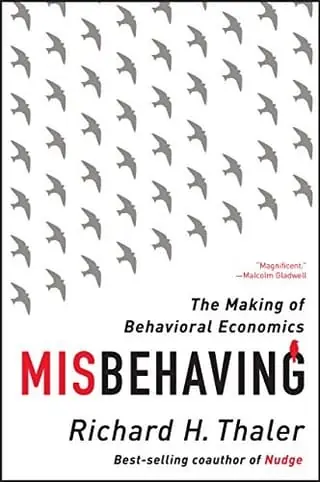
Misbehaving summary
by Richard H. Thaler · 2015 · 7 key ideas · 19-minute read
A founder of behavioral economics tells how he and a few allies proved that real people, and real markets, routinely break the rules of rational economic theory.
Why read it
For anyone curious why we overvalue what we own, waste money on sunk costs or feel cheated by price hikes: it's both an entertaining memoir and a clear guide to the quirks that drive our money decisions.
Misbehaving in brief
As a young economist, Thaler started keeping a list of things people did that economic theory said they shouldn't. People refused to sell things they owned for prices they would never pay to buy them. They drove through snowstorms to games because the tickets weren't free. Standard theory, built on rational 'Econs', had no room for these 'Humans'.
Inspired by the psychologists Daniel Kahneman and Amos Tversky, Thaler set out to explain the anomalies. He described the endowment effect, mental accounting, self-control problems and the importance of fairness. Each chapter mixes a concept with the story of how it was discovered, argued over and slowly accepted.
The establishment pushed back hard. Critics argued that mistakes would cancel out, that high stakes would make people rational, and that markets would punish error. Thaler's answer, chapter by chapter, is that they don't always. Even financial markets, supposedly the most efficient of all, show overreaction, mispricing and puzzles that rational models can't explain.
The book ends with behavioral economics going mainstream: in finance, in public policy through government nudge units, and in Thaler's own once-skeptical profession. His message is that economics becomes more useful, not less, when it describes people as they actually are.
The 7 key ideas
1. Supposedly irrelevant factors
If it shouldn't matter but does, you've found a SIF.
2. We overvalue what we own
Would you buy it today? If not, why keep it?
3. Mental accounting
A bargain you don't need is still money spent.
4. Sunk costs pull us along
The money's gone. Only the future is still yours to spend.
5. The planner and the doer
Sometimes the best option is the one you take away.
6. Fairness has a price
Customers forgive costs. They don't forgive gouging.
7. Markets misbehave too
Look less often and you'll lose your nerve less often.
Read the full guide in Kinquire. Every idea with a real example, a diagram and one thing to try today, plus a quick quiz so it sticks. Free to start.
Read MisbehavingKey takeaways
- Ask 'would I buy this today?' to escape the endowment effect.
- Ignore sunk costs: judge every choice by future costs and benefits only.
- Judge deals by the price you pay, not the discount you're shown.
- Use commitment devices to protect your long-term planner from your short-term doer.
- If you set prices, treat fairness as part of the cost.
- Check investments less often to avoid panic driven by loss aversion.
Our take
Misbehaving is a lively, generous history of how behavioral economics fought its way into the mainstream, and its examples are vivid and memorable. As a memoir, though, it tells the story from the winner's side, and some critics feel it underplays how much standard economics still explains well. Some behavioral findings have proved fragile in replication; for example, later research has questioned how universal loss aversion is. Still, its core ideas (endowment effect, mental accounting, self-control) remain widely accepted and practically useful.
About Richard H. Thaler
Richard Thaler is an economist at the University of Chicago Booth School of Business. He co-wrote Nudge with Cass Sunstein and received the 2017 Nobel Prize in economics.
If you liked this
- Nudge by Richard H. Thaler and Cass R. Sunstein
- Thinking, Fast and Slow by Daniel Kahneman
- Predictably Irrational by Dan Ariely
- The Psychology of Money by Morgan Housel
- Rich Dad Poor Dad by Robert T. Kiyosaki
- The Intelligent Investor by Benjamin Graham