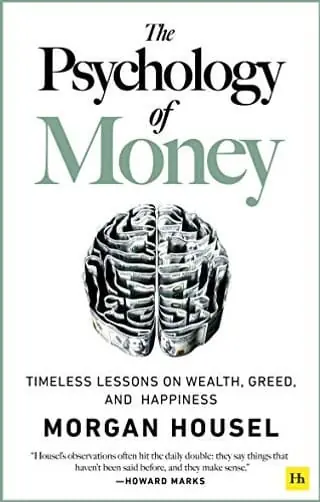
The Psychology of Money summary
by Morgan Housel · 2020 · 8 key ideas · 21-minute read
Doing well with money has less to do with how smart you are and more to do with how you behave — and behavior is hard to teach, even to clever people.
Why read it
For anyone who knows the spreadsheet answer but still makes emotional money decisions. Short, story-driven chapters reframe saving, investing and risk around patience, humility and knowing when you have enough.
The Psychology of Money in brief
Housel's starting point is that finance is taught like physics — rules, formulas, right answers — when it actually behaves like psychology. Two people can follow the same advice and get opposite results, because money decisions are made at dinner tables, not in spreadsheets, and are shaped by fear, pride, history and luck.
He shows that everyone's money views come from the slice of history they lived through, so no one is crazy — just differently experienced. Luck and risk are the invisible forces that make any outcome a poor guide to the decision behind it, which is why we should study broad patterns rather than individual heroes and villains.
The engine of wealth is compounding, and compounding needs time above all. That makes survival — staying in the game through crashes, mistakes and surprises — more important than any single brilliant move. Room for error, a high savings rate and knowing when you have enough protect you from the ruin that ends compounding early.
Housel also redefines wealth. It isn't the car you see someone drive; it's the money they didn't spend and the options it buys. Its highest dividend is control over your own time. Investing well means accepting volatility as the price of returns and choosing a strategy that is reasonable enough to stick with, not merely rational on paper.
The 8 key ideas
1. No one is crazy
Your experience is real — but it's a sample of one.
2. Luck and risk are twins
Judge the decision, not the dice.
3. Know what enough is
There is no reason to risk what you have for what you don't need.
4. Time is the secret ingredient
Good returns, held for a long time, beat great returns held briefly.
5. Survive first, then thrive
Plan on your plan not going to plan.
6. Tails drive everything
You can be wrong half the time and still make a fortune.
7. Wealth is what you don't see
Nobody is as impressed by your stuff as you are.
8. Volatility is a fee, not a fine
Pay the fee. Don't treat it like a fine.
Read the full guide in Kinquire. Every idea with a real example, a diagram and one thing to try today, plus a quick quiz so it sticks. Free to start.
Read The Psychology of MoneyKey takeaways
- Define your personal 'enough' in writing so ambition doesn't quietly reset every year.
- Build room for error: an emergency fund and spending well below income.
- Prioritise staying invested for decades over chasing the highest return.
- Treat market drops as the fee for long-term returns, and plan your response before they happen.
- Save without needing a reason — the freedom it buys is the real dividend.
- Choose a strategy you can live with emotionally, not just one that looks optimal.
Our take
Housel's great strength is reframing money as behaviour, in clear, memorable stories that stick far better than formulas. The book rarely gives step-by-step instructions, so readers wanting a concrete plan will need to pair it with something like Bogle or Collins. Some arguments rest on anecdotes chosen to fit the lesson, which is the very survivorship bias he warns about, and its examples are mostly American and fairly comfortable, so it says little about people struggling just to cover bills. Its core messages — save, stay humble, avoid ruin, think long-term — sit well with mainstream evidence and have aged well.
About Morgan Housel
Morgan Housel is a former columnist for The Motley Fool and The Wall Street Journal and a partner at the venture capital firm Collaborative Fund.
If you liked this
- Same as Ever by Morgan Housel
- The Millionaire Next Door by Thomas J. Stanley and William D. Danko
- Thinking in Bets by Annie Duke
- The Little Book of Common Sense Investing by John C. Bogle
- Rich Dad Poor Dad by Robert T. Kiyosaki
- The Intelligent Investor by Benjamin Graham