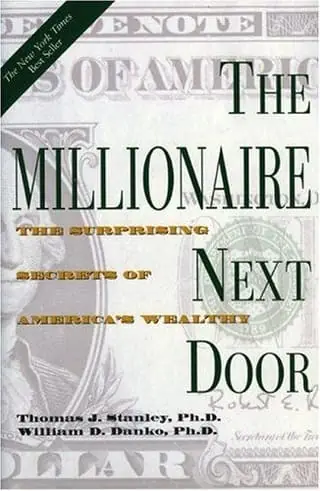
The Millionaire Next Door summary
by Thomas J. Stanley and William D. Danko · 1996 · 7 key ideas · 18-minute read
Based on surveys of wealthy Americans, this book shows that most millionaires look ordinary — they build wealth by living well below their means, not by earning or spending lavishly.
Why read it
For anyone who assumes wealth means a big salary and a flashy lifestyle. Its research-backed portrait of quiet, frugal millionaires is a powerful antidote to consumer pressure.
The Millionaire Next Door in brief
Stanley and Danko set out to discover who America's millionaires really were. Their answer surprised readers: most did not live in fancy neighbourhoods, drive luxury cars or wear expensive clothes. They were typically business owners or professionals in ordinary-sounding fields, many of them the first in their family to be wealthy, who had saved and invested steadily for decades.
The key distinction is between income and wealth. Many high earners spend almost everything and accumulate little — the authors call them under accumulators of wealth. Others, on similar or lower incomes, build substantial net worth — prodigious accumulators. A simple formula based on age and income helps readers see which group they fall into.
The book identifies common traits among the wealthy: they live well below their means; allocate time, energy and money efficiently towards building wealth; value financial independence over social status; did not depend on parents for financial help; raise adult children who are self-sufficient; spot market opportunities; and choose suitable occupations.
Along the way it criticises the way 'economic outpatient care' — ongoing financial gifts from parents to adult children — tends to weaken the recipients' own saving. The overall message is reassuring: wealth is often the result of discipline and choices that are available to many people, not a matter of looking rich.
The 7 key ideas
1. Big hat, no cattle
Wealth is what you keep, not what you show.
2. Measure yourself with the wealth formula
Not how much you earn — how much you turn into wealth.
3. Frugal, frugal, frugal
Live below your means — happily, on purpose.
4. Defence before offence
Earning is offence. Keeping is defence. Play both.
5. You aren't what you drive
Buy freedom, not admiration.
6. Economic outpatient care
Help that builds independence beats help that replaces it.
7. Ordinary businesses, extraordinary results
Boring businesses can build exciting wealth.
Read the full guide in Kinquire. Every idea with a real example, a diagram and one thing to try today, plus a quick quiz so it sticks. Free to start.
Read The Millionaire Next DoorKey takeaways
- Calculate your expected net worth with the age × income ÷ 10 formula and track it yearly.
- Know what your household really spends on food, clothing and housing.
- Decide where your next pay rise will go before it arrives.
- Choose financial independence over status purchases.
- If you help family financially, favour help that builds independence.
Our take
The Millionaire Next Door gave solid survey data to an idea that runs against popular culture: wealth usually comes from steady saving, not big spending. Its message has aged well; Stanley's daughter, Sarah Stanley Fallaw, found broadly similar patterns in The Next Millionaire Next Door (2018). Its limits are worth knowing. It studies people who succeeded, so it can't show how many frugal business owners failed. Its sample reflects 1990s America, mostly older and married households. And the wealth formula is harsh on young people. Read it as strong evidence about habits, not a guarantee.
About Thomas J. Stanley and William D. Danko
Thomas J. Stanley and William D. Danko were academic researchers who spent many years surveying and interviewing wealthy households in the United States.
If you liked this
- The Psychology of Money by Morgan Housel
- Your Money or Your Life by Vicki Robin and Joe Dominguez
- The Richest Man in Babylon by George S. Clason
- Rich Dad Poor Dad by Robert T. Kiyosaki
- The Intelligent Investor by Benjamin Graham
- I Will Teach You to Be Rich by Ramit Sethi