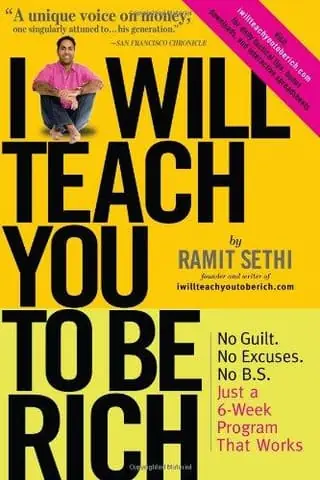
I Will Teach You to Be Rich summary
by Ramit Sethi · 2009 · 8 key ideas · 19-minute read
A six-week, no-guilt programme to set up your money once — cards, accounts, automatic investing and a conscious spending plan — so you can spend freely on what you love.
Why read it
For people in their twenties and thirties who want a practical system rather than a lecture. It's direct, funny and full of scripts and steps, and it rejects the idea that being good with money means giving up lattes.
I Will Teach You to Be Rich in brief
Sethi's starting point is that most money advice is either guilt-tripping or overwhelming. He promises something different: a six-week plan to set up a few accounts and automatic systems, after which your money mostly runs itself. The goal is not frugality for its own sake but a 'Rich Life' that you define — spending extravagantly on what you love and cutting mercilessly on what you don't.
The early weeks cover foundations: using credit cards wisely to build a strong credit score, paying them off in full and negotiating fees; and choosing low-fee, high-interest bank accounts. Next he walks readers through opening investment accounts, using any employer match first, and explains why starting now matters more than starting perfectly.
The heart of the book is the Conscious Spending Plan, a simple split of take-home pay into fixed costs, investments, savings goals and guilt-free spending. Then comes automation: money moves on payday to every destination without willpower. For investing he recommends low-cost, simple funds — such as target-date or index funds — over stock-picking.
Throughout, Sethi focuses on 'Big Wins' — automation, investing early, negotiating salary, and big purchases like homes and cars — rather than tiny cutbacks. He finishes by urging readers to keep the system simple, check it only occasionally, and use the time it frees up to live well.
The 8 key ideas
1. Define your Rich Life
Spend big on what you love; spend nothing on what you don't.
2. Chase Big Wins, not lattes
Big Wins beat small sacrifices.
3. Make credit cards work for you
Pay in full, automatically — and always ask.
4. The Conscious Spending Plan
Cover the important stuff, then spend the rest guilt-free.
5. Automate everything
Decide once; let the system do it forever.
6. Start now, not perfectly
Good enough today beats perfect someday.
7. Keep investing boring
Boring investing is profitable investing.
8. Earn more by asking
Costs have a floor. Earnings don't.
Read the full guide in Kinquire. Every idea with a real example, a diagram and one thing to try today, plus a quick quiz so it sticks. Free to start.
Read I Will Teach You to Be RichKey takeaways
- Write your own definition of a Rich Life and spend on it without guilt.
- Focus on Big Wins: salary, automatic investing, housing and cars.
- Pay credit cards in full automatically, and call to ask for fees to be waived.
- Split take-home pay into fixed costs, investments, savings goals and guilt-free spending.
- Automate transfers for the day after payday.
- Invest in low-cost diversified funds and leave them alone.
Our take
Sethi's book is one of the most practical personal finance guides around: specific steps, real scripts and a refreshing refusal to shame spending. Its focus on automation and low-cost funds lines up with mainstream evidence. The downsides: it's heavily US-specific, so readers elsewhere must translate account types and credit rules, and its breezy confidence assumes a steady income and some surplus to work with. Its brash marketing tone isn't for everyone. The second edition (2019) updated the details, and the core system has aged well.
About Ramit Sethi
Ramit Sethi studied at Stanford University and started the blog I Will Teach You to Be Rich in 2004. A revised second edition of the book appeared in 2019.
If you liked this
- The Psychology of Money by Morgan Housel
- The Simple Path to Wealth by JL Collins
- The Little Book of Common Sense Investing by John C. Bogle
- Your Money or Your Life by Vicki Robin and Joe Dominguez
- Rich Dad Poor Dad by Robert T. Kiyosaki
- The Intelligent Investor by Benjamin Graham