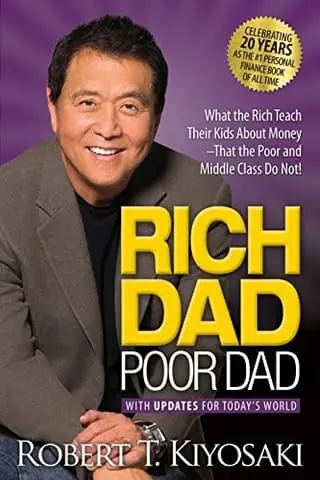
Rich Dad Poor Dad summary
by Robert T. Kiyosaki · 1997 · 8 key ideas · 21-minute read
A parable of two fathers that argues the rich get richer by buying assets that pay them, while everyone else works for money and buys liabilities they mistake for assets.
Why read it
For anyone who was taught to get a good job and never taught how money actually works. It's less a how-to manual than a mindset shift — and one of the best-selling personal finance books ever written.
Rich Dad Poor Dad in brief
Kiyosaki describes growing up with two father figures. His own father, 'poor dad', was highly educated, worked hard in a secure government job and still struggled with money. His best friend's father, 'rich dad', left school early but became wealthy by building businesses and buying property. The two men gave opposite advice, and the book is Kiyosaki's case for following the rich one.
The central lesson is financial literacy: knowing the difference between an asset, which puts money in your pocket, and a liability, which takes it out. Most people, he argues, spend their lives working for money, then use rising pay to buy bigger houses and cars — liabilities — which keeps them trapped in what he calls the rat race.
The way out is to 'mind your own business': keep your job, but focus on building a column of assets — businesses, property, paper investments, royalties — whose income eventually covers your expenses. Along the way he praises the tax advantages of corporations, the courage to take calculated risks and the habit of paying yourself first.
Finally, he urges readers to work to learn rather than to earn: pick jobs for the skills they teach, especially selling and communicating, and treat fear, laziness, cynicism and arrogance as the real obstacles to wealth. The tone is motivational and anecdotal rather than technical.
The 8 key ideas
1. The rich don't work for money
Feel the fear, then think — don't let it pick your job.
2. Assets feed you, liabilities eat you
Does it put money in your pocket, or take it out?
3. Why the rich get richer
Assets first. Luxuries last, paid by the assets.
4. Mind your own business
Keep your day job. Build your real business on the side.
5. Financial IQ has four parts
Money follows knowledge — and a bit of nerve.
6. Corporations play by different tax rules
Learn the rules of the game you're already playing.
7. Work to learn, not to earn
Best-selling beats best-writing.
8. Pay yourself first
First payment of the month goes to you.
Read the full guide in Kinquire. Every idea with a real example, a diagram and one thing to try today, plus a quick quiz so it sticks. Free to start.
Read Rich Dad Poor DadKey takeaways
- Track your money by cash flow: does each thing you own pay you or cost you every month?
- Direct part of every raise into assets before lifestyle upgrades.
- Keep your job but build an asset column alongside it.
- Learn one financial skill properly — reading accounts, tax basics or selling.
- Automate investing as the first payment of the month, while still paying every bill on time.
Our take
Rich Dad Poor Dad's lasting gift is its simple, memorable framing: assets versus liabilities, and the trap of spending every raise. It has motivated millions to think about money for the first time. Its weaknesses are serious, though. Advice is vague on how to actually find good investments, risks are downplayed, US tax material is simplified, and some suggestions — like paying yourself before bills — can backfire. Critics have also questioned whether 'rich dad' was a real single person, and its anecdotes can't be checked. Read it for mindset, then use more rigorous books for the how-to.
About Robert T. Kiyosaki
Robert Kiyosaki grew up in Hawaii and served as a US Marine Corps pilot during the Vietnam War. He wrote the book with accountant Sharon Lechter.
If you liked this
- The Richest Man in Babylon by George S. Clason
- The Millionaire Next Door by Thomas J. Stanley and William D. Danko
- The Psychology of Money by Morgan Housel
- The Intelligent Investor by Benjamin Graham
- I Will Teach You to Be Rich by Ramit Sethi
- A Random Walk Down Wall Street by Burton G. Malkiel