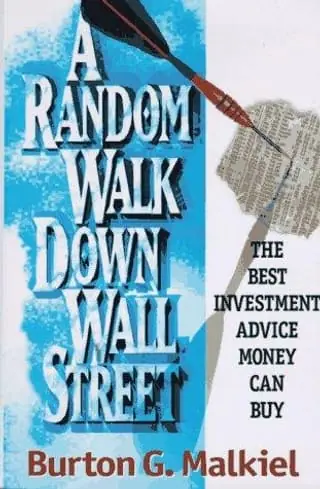
A Random Walk Down Wall Street summary
by Burton G. Malkiel · 1973 · 8 key ideas · 21-minute read
Stock prices move in ways no one can reliably predict, so most people will do best by owning the whole market through low-cost index funds and holding on.
Why read it
For anyone tempted by stock tips, charts or star fund managers. Malkiel combines market history, economics and behavioural finance into the classic case for simple, low-cost investing.
A Random Walk Down Wall Street in brief
Malkiel starts with two ways of valuing investments. The firm-foundation view says every asset has an intrinsic value based on its future cash flows. The castle-in-the-air view says prices depend on what others will pay, driven by crowd psychology. History, he shows, is full of times when castle-building ran wild — from Dutch tulips to the dot-com boom.
He then examines whether professionals can beat the market. Technical analysts who read charts, he argues, find patterns in what are mostly random movements. Fundamental analysts face a tougher problem: new information is reflected in prices so quickly that it's hard to profit from. Over long periods, most actively managed funds fail to beat a simple index after costs.
This is the 'random walk': short-term price changes are essentially unpredictable. Malkiel discusses the efficient market hypothesis, its critics and the findings of behavioural finance, which shows how overconfidence and herding lead investors astray. He concedes markets aren't perfectly efficient, but argues that exploiting their errors reliably is extremely hard.
The practical conclusion is a guide for ordinary investors: build an emergency fund, use tax-advantaged accounts, match your mix of stocks and bonds to your age and temperament, rebalance, invest regularly, and above all buy broad, low-cost index funds and hold them for the long term.
The 8 key ideas
1. Foundations vs castles in the air
Value is a foundation; hype is a castle in the air.
2. Bubbles always come back
'This time is different' rarely is.
3. Charts can't see the future
A chart is a rear-view mirror.
4. Markets digest news fast
If you read it in the news, the market already knows.
5. The monkey and the managers
Stop searching for the winner — own the whole race.
6. Your brain is the risk
Know your biases — then build guard rails against them.
7. Invest for your stage of life
Time horizon decides risk, not mood.
8. Buy the index, hold it
Own everything, pay little, wait long.
Read the full guide in Kinquire. Every idea with a real example, a diagram and one thing to try today, plus a quick quiz so it sticks. Free to start.
Read A Random Walk Down Wall StreetKey takeaways
- Ignore charts, tips and short-term predictions — they mostly reflect noise.
- Be suspicious when an asset's main appeal is that its price has risen.
- Check fees on every fund you own and favour low-cost index funds.
- Set a stock–bond mix that matches your time horizon, and rebalance yearly.
- Write an investing policy in calm times so biases don't decide for you in a panic.
Our take
A Random Walk has stayed influential for fifty years because its core advice — own the market cheaply and hold on — has largely been vindicated as index funds have grown. Malkiel writes accessibly and fairly, and later editions take behavioural critics seriously. Still, the efficient market hypothesis remains contested: bubbles themselves suggest prices can be badly wrong, and researchers have documented persistent patterns like value and momentum. Malkiel's answer — such patterns are hard to exploit after costs — is persuasive but not the final word. The middle chapters on valuation theory can be heavy going for beginners.
About Burton G. Malkiel
Burton G. Malkiel is an economist and long-serving professor at Princeton University who also served on the US President's Council of Economic Advisers.
If you liked this
- The Little Book of Common Sense Investing by John C. Bogle
- The Intelligent Investor by Benjamin Graham
- The Simple Path to Wealth by JL Collins
- The Psychology of Money by Morgan Housel
- Rich Dad Poor Dad by Robert T. Kiyosaki
- I Will Teach You to Be Rich by Ramit Sethi