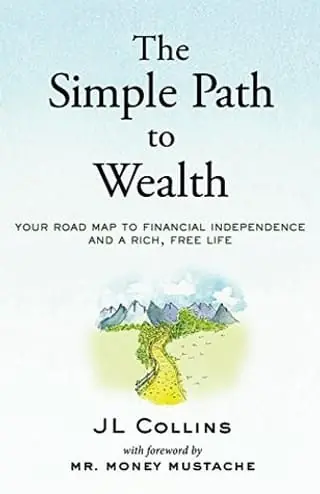
The Simple Path to Wealth summary
by JL Collins · 2016 · 8 key ideas · 19-minute read
Spend less than you earn, avoid debt, and invest the difference in a broad, low-cost stock index fund — then hold on through every crash until you're financially free.
Why read it
For anyone who wants financial independence without becoming a finance hobbyist. Written in plain, friendly language, it's a favourite of the FIRE community for its clarity and simplicity.
The Simple Path to Wealth in brief
Collins wrote the book for his daughter, who wanted to be financially secure but had little interest in money. His aim is a path simple enough to follow without much thought. It rests on three habits: spend less than you earn, invest the surplus, and avoid debt.
The goal is freedom — what he bluntly calls 'F-you money', enough to walk away from a bad job or situation. Debt is the enemy of that freedom, so he urges readers to treat it as an emergency and to avoid car loans and consumer credit altogether.
For investing, Collins argues that the stock market is the most powerful wealth-building tool available, and that over the long run it has always gone up — despite frequent, terrifying crashes. Most people lose money not because of the market but because they panic and sell. His solution is to buy a single, broad, low-cost total stock market index fund and hold it.
He distinguishes a wealth-building phase, when you can hold almost all stocks, from a wealth-preservation phase, when you add bonds to smooth the ride. He covers tax-advantaged accounts, explains why he favours Vanguard, discusses safe withdrawal rates like the 4% rule, and warns against most paid financial advisers.
The 8 key ideas
1. Three simple habits
Earn, spend less, invest the gap.
2. Build F-you money
Savings buy you the power to say no.
3. Treat debt as an emergency
Every payment you don't owe can be invested.
4. The market always goes up — eventually
Crashes are part of the ride, not the end of it.
5. Your behaviour is the real risk
The market doesn't lose your money — panic does.
6. One fund can do it all
Simple beats clever — and costs less.
7. Build, then preserve
Grow it boldly; protect it wisely.
8. Know your safe withdrawal rate
Twenty-five times your spending, and stay flexible.
Read the full guide in Kinquire. Every idea with a real example, a diagram and one thing to try today, plus a quick quiz so it sticks. Free to start.
Read The Simple Path to WealthKey takeaways
- Track your savings rate and push it higher each year.
- Build F-you money: several months of expenses at minimum.
- Treat high-interest debt as an emergency and avoid car loans.
- Invest in one broad, low-cost index fund and keep adding.
- Write a crash plan in advance and stick to it.
- Multiply your annual spending by 25 to set your independence target.
Our take
The Simple Path to Wealth is one of the clearest introductions to index investing and financial independence, and its insistence on simplicity is a real strength. Its weak spots: it leans heavily on US market history and US-specific accounts, recommends an all-stock portfolio that many people may not have the nerves for, and promotes a single provider. The 4% rule has been debated as valuations and interest rates change. Readers elsewhere should translate the principles to local funds and accounts. As a mindset and starting framework, it holds up well.
About JL Collins
JL Collins is an American writer whose blog posts on investing, especially his 'Stock Series', grew into this book. Many of the ideas began as letters to his daughter.
If you liked this
- The Little Book of Common Sense Investing by John C. Bogle
- Your Money or Your Life by Vicki Robin and Joe Dominguez
- A Random Walk Down Wall Street by Burton G. Malkiel
- I Will Teach You to Be Rich by Ramit Sethi
- The Psychology of Money by Morgan Housel
- Rich Dad Poor Dad by Robert T. Kiyosaki