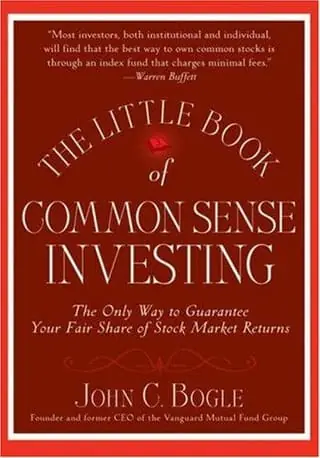
The Little Book of Common Sense Investing summary
by John C. Bogle · 2007 · 8 key ideas · 21-minute read
Since investors as a group can only earn the market's return minus their costs, the winning strategy is to own the whole market at the lowest possible cost and hold it forever.
Why read it
For anyone choosing funds for a pension or ISA. The founder of the first retail index fund lays out, in short chapters, why cheap and simple almost always beats clever and expensive.
The Little Book of Common Sense Investing in brief
Bogle's argument rests on simple arithmetic. All investors together own the whole stock market, so before costs they must earn the market's return as a group. Every pound paid in fees, commissions and trading costs comes out of that shared return. After costs, therefore, the average investor must lag the market — and the more they pay, the further behind they fall.
The only way to guarantee capturing nearly all of the market's return is to own the entire market through a broad, low-cost index fund. Bogle calls this the 'haystack' approach: instead of searching for the few needles that will win, buy the whole haystack.
He then dismantles the alternatives. Fund managers who beat the market rarely keep doing so; performance reverts to the mean. Investors chasing hot funds tend to buy high and sell low, earning even less than the funds they own. Small differences in annual costs compound into enormous differences over decades.
Bogle extends the case to bonds and asset allocation, warns against trading index funds or chasing new 'smarter' indexes, and urges readers to stay the course through good times and bad. His message is that the simplest strategy is also the most reliable.
The 8 key ideas
1. The Gotrocks family
Fire the Helpers.
2. The relentless rules of arithmetic
Before costs, zero-sum. After costs, a loser's game.
3. Costs compound too
Time is your friend; cost is your enemy.
4. Buy the haystack
Don't hunt needles. Own the haystack.
5. Stars fade
Pick funds on cost, not on last year's stars.
6. Investors earn less than their funds
Stay the course.
7. Beware 'better' index funds
Broad, cheap, held — or it isn't really indexing.
8. Balance with bonds, then stay the course
Pick a mix you can sleep with — then stay the course.
Read the full guide in Kinquire. Every idea with a real example, a diagram and one thing to try today, plus a quick quiz so it sticks. Free to start.
Read The Little Book of Common Sense InvestingKey takeaways
- Look up the total annual cost of every fund you own and know it in pounds.
- Use a broad, low-cost index fund as the core of your portfolio.
- Choose funds on cost, not on recent performance.
- Avoid frequent trading, even in index funds.
- Pick a stock–bond mix that fits your age and temperament, and rebalance occasionally.
- Stay the course through market falls.
Our take
Bogle's book has proved one of the most influential personal finance texts ever: its central claim — that costs matter enormously and most investors are better off indexing — is backed by decades of data and has reshaped the fund industry. It's also short and clear. The weaknesses are mostly of tone and scope: it repeats its core point many times, focuses on US funds, and Bogle's scepticism of ETFs and factor investing is more contested than his main argument. Some critics also worry about what happens to market pricing if indexing becomes overwhelmingly dominant.
About John C. Bogle
John C. Bogle founded the Vanguard Group in 1975 and launched the first index mutual fund for individual investors. He died in 2019.
If you liked this
- A Random Walk Down Wall Street by Burton G. Malkiel
- The Simple Path to Wealth by JL Collins
- The Intelligent Investor by Benjamin Graham
- The Psychology of Money by Morgan Housel
- Rich Dad Poor Dad by Robert T. Kiyosaki
- I Will Teach You to Be Rich by Ramit Sethi