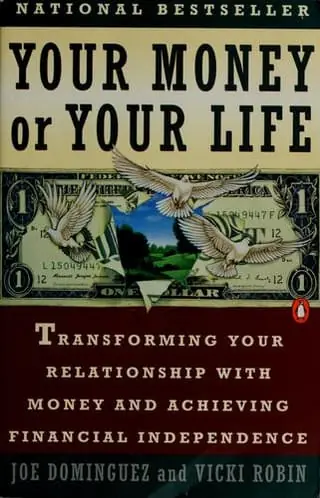
Your Money or Your Life summary
by Vicki Robin and Joe Dominguez · 1992 · 8 key ideas · 21-minute read
Money is something you trade your life energy for, so a nine-step programme helps you spend only on what truly fulfils you and reach the point where investments cover your needs.
Why read it
For anyone who feels busy, well-paid and still unsatisfied. It reframes spending in hours of your life and is a founding text of the modern financial independence (FIRE) movement.
Your Money or Your Life in brief
Robin and Dominguez begin with a question: what is money, really? Their answer is that money is something we trade our life energy for — the limited hours of our one life. Seen that way, every purchase costs a piece of your life, and the question becomes whether it was worth it.
The book then sets out nine steps. You calculate everything you've ever earned and what you have to show for it. You work out your real hourly wage, after the hidden costs and time of working. You track every penny, tally it each month and convert it into hours of life. Then you ask three questions of each category of spending, and chart your income and spending on a wall chart.
Through this process, spending naturally falls as people stop buying things that don't bring fulfilment. The authors describe a 'fulfilment curve' that peaks at 'enough' — the point beyond which more stuff adds burden rather than joy. Separately, they suggest rethinking the relationship between your work and your paid job, and finding ways to raise income.
Savings are invested to produce income. When monthly investment income exceeds monthly spending — the crossover point — you're financially independent and paid work becomes optional. The goal isn't early retirement for its own sake, but a life aligned with your values.
The 8 key ideas
1. Money is life energy
You don't spend money. You spend life.
2. Find your real hourly wage
Your job pays less per hour than your payslip says.
3. Make peace with the past
Count it, forgive it, move on.
4. Track every penny
What gets seen gets changed.
5. Ask the three questions
Was it worth the life it cost?
6. Find your 'enough'
Enough is a peak, not a starting line.
7. Work is bigger than your job
Your job is what you're paid for. Your work is what you're for.
8. Reach the crossover point
Lower one line, raise the other, and they'll cross.
Read the full guide in Kinquire. Every idea with a real example, a diagram and one thing to try today, plus a quick quiz so it sticks. Free to start.
Read Your Money or Your LifeKey takeaways
- Calculate your real hourly wage and use it to price purchases in hours of life.
- Track every penny for a month and total it by category.
- Ask the three questions of each spending category and cut the ones with minuses.
- Define your 'enough' and stop spending past it.
- Draw a crossover chart to make financial independence concrete.
Our take
Your Money or Your Life is less a finance manual than a philosophy of money, and its central reframe — money as life energy — has influenced a generation of savers and the FIRE movement. Its tools (real hourly wage, three questions, wall chart) are simple and powerful. Its weaknesses: the daily tracking is demanding; the original investing advice, centred on long-term Treasury bonds, aged badly; and the path to independence is much harder on low incomes or with high housing costs. Later editions updated the details. The core questions about value and 'enough' remain fresh.
About Vicki Robin and Joe Dominguez
Joe Dominguez left a career as a Wall Street analyst in his early thirties and spent decades teaching his approach to money; Vicki Robin, a writer and activist, worked with him and co-wrote the book. Dominguez died in 1997.
If you liked this
- The Simple Path to Wealth by JL Collins
- The Millionaire Next Door by Thomas J. Stanley and William D. Danko
- The Psychology of Money by Morgan Housel
- Die with Zero by Bill Perkins
- Rich Dad Poor Dad by Robert T. Kiyosaki
- The Intelligent Investor by Benjamin Graham