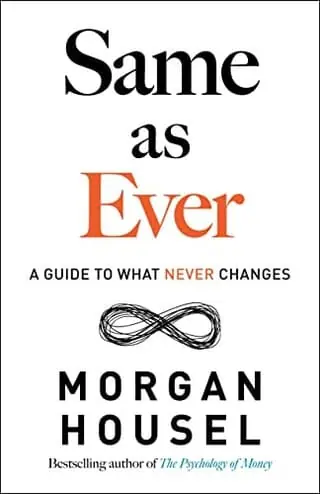
Same as Ever summary
by Morgan Housel · 2023 · 8 key ideas · 19-minute read
The future is impossible to predict, but human behaviour — greed, fear, storytelling, impatience — stays the same, so build your decisions on what never changes.
Why read it
For anyone tired of forecasts that keep failing. In short, story-driven chapters, Housel shows how lasting patterns of behaviour explain risk, markets, careers and happiness better than predictions do.
Same as Ever in brief
Housel starts from a humbling fact: nobody can reliably predict the future. History is shaped by surprises and small chance events that compound into enormous consequences. But while specific events are unpredictable, the way people respond to them is remarkably stable. Fear, greed, envy, overconfidence and the hunger for good stories repeat across centuries.
So instead of asking what will change, he suggests asking what won't. The book is a collection of short chapters, each describing one of these enduring patterns. The biggest risks are the ones nobody sees coming. Happiness depends on the gap between results and expectations. Long periods of calm breed the overconfidence that causes the next crisis.
Other chapters explore why bad news arrives suddenly while progress is slow and quiet; why the best story, not the best idea, tends to win; why efficiency and perfection can make systems fragile; why incentives explain so much behaviour; and why anything worth doing comes with a price in pain and uncertainty.
The practical message is to prepare rather than predict: keep room for error, expect surprises, manage your expectations and hold a long time horizon. Housel argues that understanding human nature is the most reliable guide we have to an unpredictable future.
The 8 key ideas
1. Prepare, don't predict
Expect surprises. Don't bet on which one.
2. History hangs by a thread
Big outcomes often hang on small threads.
3. Happiness is results minus expectations
Raise your results faster than your expectations.
4. Calm plants the seeds of crazy
The calmer it feels, the more careful you should be.
5. Fast tragedies, slow miracles
Tragedies are loud. Progress whispers.
6. The best story wins
Being right isn't enough. You have to be heard.
7. Leave room for inefficiency
A little waste is cheap insurance.
8. Incentives explain almost everything
Find the incentive and you'll usually find the explanation.
Read the full guide in Kinquire. Every idea with a real example, a diagram and one thing to try today, plus a quick quiz so it sticks. Free to start.
Read Same as EverKey takeaways
- Prepare for surprises with buffers rather than trying to predict specific events.
- Manage your expectations as carefully as your results.
- Be most careful with debt and risk when times feel calmest.
- Look past sudden bad news to the slower long-term trends.
- Learn to tell your ideas as stories — and question stories told to you.
- Check the incentives behind any advice before acting on it.
Our take
Same as Ever is a thoughtful, highly readable collection of timeless patterns, and its central move — focusing on what doesn't change — is genuinely useful in a world obsessed with forecasts. Housel writes with clarity and memorable stories. The flip side is that it's more a set of essays than a sustained argument, and some readers will find it repeats themes from The Psychology of Money. Its lessons are broad rather than actionable, and, like many story-driven books, it chooses examples that fit the point. As a lens for thinking about risk and human nature, it holds up well.
About Morgan Housel
Morgan Housel is a partner at the venture capital firm Collaborative Fund and the author of The Psychology of Money. He previously wrote for The Motley Fool and The Wall Street Journal.
If you liked this
- The Psychology of Money by Morgan Housel
- The Black Swan by Nassim Nicholas Taleb
- Factfulness by Hans Rosling with Ola Rosling and Anna Rosling Rönnlund
- Antifragile by Nassim Nicholas Taleb
- Rich Dad Poor Dad by Robert T. Kiyosaki
- The Intelligent Investor by Benjamin Graham