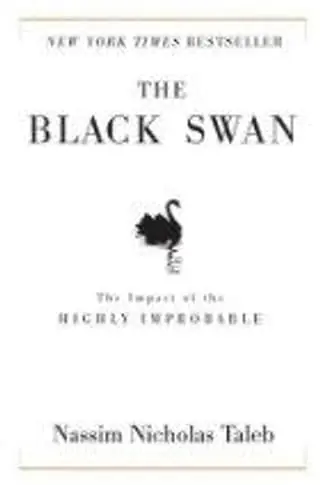
The Black Swan summary
by Nassim Nicholas Taleb · 2007 · 8 key ideas · 21-minute read
Rare, unpredictable events with enormous impact shape history, markets and our lives, so instead of trying to predict them, we should build lives and systems that survive them and benefit from the good ones.
Why read it
For anyone who makes decisions under uncertainty, from investing to planning a career: it exposes the limits of forecasting and offers a more robust way to handle what you can't know.
The Black Swan in brief
Europeans once believed all swans were white, because every swan they had ever seen was white. The sighting of black swans in Australia overturned that certainty in an instant. Taleb uses this to name a kind of event: one that lies outside normal expectations, has an extreme impact, and is explained away afterwards as if it had been predictable.
He argues that Black Swans, such as wars, financial crashes, technological breakthroughs or the success of a single bestseller, account for much of what matters in history. Yet our minds and our tools are built for a tamer world. We tell neat stories after the fact, ignore evidence we can't see, mistake games of chance for real life and trust forecasts that have a poor track record.
Taleb distinguishes between two kinds of randomness. In Mediocristan, things like height or weight vary within narrow limits, and no single case changes the total much. In Extremistan, things like wealth, book sales or market moves can be dominated by a single extreme case. Applying the tools of Mediocristan, such as the bell curve, to Extremistan is, he argues, dangerous.
His advice is not to predict Black Swans but to prepare for them. Protect yourself from negative ones, expose yourself to positive ones, be humble about what you know and treat confident forecasts with suspicion. His barbell strategy, combining extreme safety with small, bold bets, is one practical way to do this.
The 8 key ideas
1. What makes a Black Swan
The biggest events are the ones nobody saw coming.
2. The turkey problem
A thousand calm days prove nothing about day 1,001.
3. Mediocristan and Extremistan
In Extremistan, the average lies and the outlier rules.
4. The narrative fallacy
If the story is too neat, check what it left out.
5. Silent evidence
Always ask: where are the ones who drowned?
6. The ludic fallacy
Life isn't a casino. The odds aren't printed on the table.
7. Distrust forecasts
Plan for ranges, not points.
8. The barbell strategy
Protect the floor; leave the ceiling open.
Read the full guide in Kinquire. Every idea with a real example, a diagram and one thing to try today, plus a quick quiz so it sticks. Free to start.
Read The Black SwanKey takeaways
- Expect the unexpected: plan for events you can't predict.
- Don't take a long calm record as proof of safety.
- Ask whether you're in Mediocristan or Extremistan before trusting averages.
- Look for silent evidence: study the failures, not just the winners.
- Avoid relying on precise forecasts; build buffers for a range of outcomes.
- Use a barbell: keep the core safe and make small bets with big upside.
Our take
The Black Swan was published shortly before the 2008 financial crisis, which made its warnings about hidden risks in banking look prophetic and turned it into a bestseller. Its central ideas, fat tails, survivorship bias, the limits of forecasting, have deeply influenced risk thinking. But Taleb's tone is combative and sometimes dismissive of entire professions, and critics argue he overstates how much economists ignore extreme events. His idea of Black Swans can also be stretched to explain anything after the fact. Read it for its powerful mental models rather than its polemics.
About Nassim Nicholas Taleb
Nassim Nicholas Taleb is a Lebanese-American essayist and former options trader. The Black Swan is part of his multi-book series on uncertainty, the Incerto, which also includes Fooled by Randomness and Antifragile.
If you liked this
- Antifragile by Nassim Nicholas Taleb
- Thinking, Fast and Slow by Daniel Kahneman
- The Psychology of Money by Morgan Housel
- Rich Dad Poor Dad by Robert T. Kiyosaki
- The Intelligent Investor by Benjamin Graham
- I Will Teach You to Be Rich by Ramit Sethi