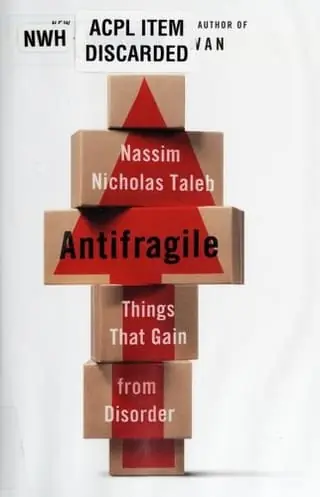
Antifragile summary
by Nassim Nicholas Taleb · 2012 · 7 key ideas · 18-minute read
Some things don't just survive shocks and volatility but get stronger from them, and the wise course is to build lives, businesses and societies that gain from disorder.
Why read it
For anyone who wants to stop chasing perfect predictions and instead design a career, portfolio or organization that benefits when the unexpected happens.
Antifragile in brief
In The Black Swan, Taleb argued that rare, unpredictable events shape the world. Antifragile asks what to do about it. His answer is a new concept. We have a word for things that break under stress (fragile) and things that withstand it (robust), but no word for things that get better with stress. He coins one: antifragile.
Antifragility is everywhere in nature. Muscles grow when stressed, immune systems strengthen with exposure, and evolution improves species through the failure of individuals. Taleb argues that modern societies often make things fragile by trying to remove all volatility, smoothing out small shocks only to build up catastrophic ones.
He then sets out how to become antifragile. Seek options, which give you more upside than downside from uncertainty. Use a barbell: be very safe in some areas and take small risks with big potential in others. Remove harmful things before adding new ones. Trust old, time-tested practices. And make sure decision-makers have skin in the game, bearing the costs of their own mistakes.
The book ranges across medicine, economics, politics, ethics and personal life. It is written in Taleb's distinctive combative style, with characters like the street-smart trader Fat Tony mocking 'fragilistas', the experts and officials who harm systems by over-managing them. Underneath the polemics is a practical message: stop trying to predict shocks, and start positioning yourself to benefit from them.
The 7 key ideas
1. Beyond robust
Don't just survive the shock. Feed on it.
2. Stressors are information
Smooth on the surface can mean fragile underneath.
3. Fragile parts, antifragile whole
Let small things fail so big things don't.
4. Beware the fragilista
When in doubt, don't tinker.
5. Options beat predictions
You don't need to be right. You need options.
6. Subtract before you add
Ask first what to take away.
7. Skin in the game
Don't trust anyone who won't eat their own cooking.
Read the full guide in Kinquire. Every idea with a real example, a diagram and one thing to try today, plus a quick quiz so it sticks. Free to start.
Read AntifragileKey takeaways
- Classify key parts of your life as fragile, robust or antifragile, and improve the weakest.
- Seek small, regular stressors that build strength and reveal weaknesses.
- Let small failures happen and learn from them, to avoid one big failure.
- Buy cheap options: small bets with limited downside and large upside.
- Improve by subtraction first: remove what harms you.
- Trust advisers who share the downside of their advice.
Our take
Antifragile offers a genuinely useful idea: that we should design for gain from disorder, not just protection from it. Its practical rules (options, barbells, subtraction, skin in the game) are memorable and widely applicable. But the book is long, digressive and often abrasive, with sweeping attacks on academics, economists and journalists. Some claims, such as broad assertions about health or history, rest more on intuition and anecdote than on solid evidence. The concept is also easy to stretch: almost anything can be described as antifragile after the fact. Take the principles, and treat the polemics with care.
About Nassim Nicholas Taleb
Nassim Nicholas Taleb is a Lebanese-American essayist, former options trader and author of The Black Swan. Antifragile is part of his Incerto series on uncertainty, risk and decision-making.
If you liked this
- The Black Swan by Nassim Nicholas Taleb
- Thinking in Bets by Annie Duke
- The Psychology of Money by Morgan Housel
- Rich Dad Poor Dad by Robert T. Kiyosaki
- The Intelligent Investor by Benjamin Graham
- I Will Teach You to Be Rich by Ramit Sethi