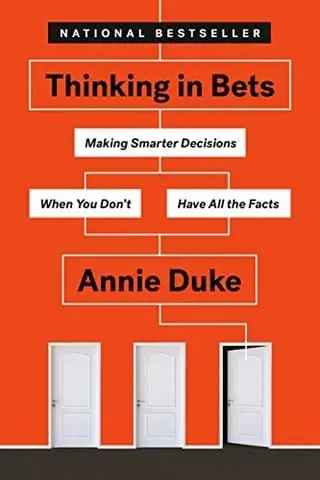
Thinking in Bets summary
by Annie Duke · 2018 · 7 key ideas · 19-minute read
Every decision is a bet on an uncertain future, so judge decisions by their quality rather than their outcomes, and build habits and groups that help you see the world more accurately.
Why read it
For anyone who makes decisions under uncertainty — which is everyone. It is especially useful if you tend to beat yourself up over bad outcomes, or take too much credit for good ones.
Thinking in Bets in brief
Duke starts from a simple observation drawn from poker: you can play a hand perfectly and still lose, or play badly and win. Life works the same way. Outcomes are a mix of decision quality and luck, and because we only see one outcome, we routinely confuse the two — a habit she calls ‘resulting’.
Treating decisions as bets helps. A bet makes you consider what you believe, how confident you are and what could happen. Duke urges us to express beliefs in probabilities rather than certainties, to say ‘I’m not sure’ more often, and to update beliefs when new information arrives.
Our brains make this hard. We tend to believe what we hear without checking, interpret evidence to protect our beliefs and our self-image, and credit our own wins to skill while blaming losses on luck. Smart people are not immune; they can be better at rationalising.
Her remedies are social and temporal. Build a ‘decision pod’ of people committed to truthseeking, with clear norms for sharing information and challenging each other. And use mental time travel — imagining future and past selves, running premortems, setting precommitments — to make better choices in the moment.
The 7 key ideas
1. Don’t judge decisions by results
Judge the choice, not the coin flip.
2. Life is poker, not chess
You can’t see all the cards. Decide anyway — wisely.
3. Wanna bet?
Say how sure you are, not just what you think.
4. We believe what we hear
Ask where a belief came from before defending it.
5. Field your outcomes fairly
Be proud of judging accurately, not of being right.
6. Build a truthseeking group
Find people who care more about truth than comfort.
7. Travel in time to decide better
Ask your future self before you act.
Read the full guide in Kinquire. Every idea with a real example, a diagram and one thing to try today, plus a quick quiz so it sticks. Free to start.
Read Thinking in BetsKey takeaways
- Review decisions by what you knew and how you reasoned, not just by results.
- Attach a confidence percentage to important beliefs and update in small steps.
- When fielding outcomes, look for luck in your wins and lessons in your losses.
- Form a small group that reviews decisions without revealing outcomes first.
- Run a premortem before big plans and set precommitments for tempting moments.
Our take
Thinking in Bets is a practical, readable bridge between poker and decision science, and its core lesson — separate decision quality from outcome — is genuinely valuable. Much of its psychology repeats material from Kahneman, Tetlock and others, and some readers find the poker stories stretched. It is also easier to say ‘it was bad luck’ than to know it: separating luck from skill in a single outcome is often impossible, and the framework can be used to excuse poor decisions. Used honestly, it encourages humility and better learning.
About Annie Duke
Annie Duke is a former professional poker player who won a World Series of Poker bracelet in 2004. Before poker she did graduate work in cognitive psychology at the University of Pennsylvania.
If you liked this
- Thinking, Fast and Slow by Daniel Kahneman
- Good to Great by Jim Collins
- Built to Last by Jim Collins and Jerry I. Porras
- The Innovator's Dilemma by Clayton M. Christensen
- Blue Ocean Strategy by W. Chan Kim and Renée Mauborgne
- Good Strategy Bad Strategy by Richard Rumelt