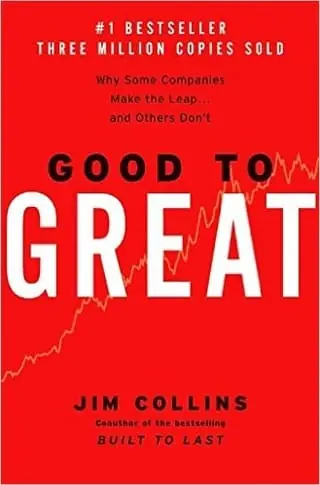
Good to Great summary
by Jim Collins · 2001 · 7 key ideas · 20-minute read
Ordinary companies become great not through a single bold stroke but through disciplined people, disciplined thought and disciplined action, compounded patiently over years.
Why read it
For anyone running a team or a company who wants a research-based picture of what separates sustained excellence from mere competence. Its vocabulary — Level 5 leaders, the Hedgehog Concept, the flywheel — is still everywhere in management.
Good to Great in brief
Collins and a research team searched decades of stock data for companies that had been merely average for fifteen years, hit a transition point, and then beat the market by a wide margin for the next fifteen. Only eleven qualified, including Kimberly-Clark, Walgreens, Nucor and Gillette. Each was paired with a similar company in the same industry that had the same chance and failed to take it.
The surprise was what did not matter: celebrity CEOs, big acquisitions, technology bets, fancy pay packages and dramatic change programs. Instead the great companies were led by quietly humble but fiercely determined leaders, who first assembled the right people and only then decided on direction.
Those teams faced the hard facts about their situation without losing faith that they would win. They found a simple Hedgehog Concept at the overlap of what they could be best in the world at, what drove their economics, and what they cared about deeply — and then had the discipline to say no to everything else.
The result looked like a sudden breakthrough from outside, but inside it felt like pushing a giant flywheel: many small, consistent turns in the same direction, building momentum until it seemed to spin by itself. The comparison companies, by contrast, lurched from one big program to the next in a doom loop.
Collins frames the whole thing as build-up followed by breakthrough: disciplined people, then disciplined thought, then disciplined action. And he opens with the line that gives the book its sting: good is the enemy of great, because being good enough removes the pressure to become excellent.
The 7 key ideas
1. Level 5 leadership
Window for credit, mirror for blame.
2. First who, then what
Pick the crew before you pick the course.
3. The Stockdale Paradox
Faith in the ending, honesty about today.
4. The Hedgehog Concept
Know one big thing, and say no to the rest.
5. A culture of discipline
Your stop-doing list matters as much as your to-do list.
6. Technology accelerates, it doesn’t create
Technology multiplies what you already are.
7. The flywheel and the doom loop
No miracle moment — just turn after turn.
Read the full guide in Kinquire. Every idea with a real example, a diagram and one thing to try today, plus a quick quiz so it sticks. Free to start.
Read Good to GreatKey takeaways
- Build teams of people you would rehire with enthusiasm before you fix the plan.
- Create channels where bad news reaches you quickly and without blame.
- Define your Hedgehog Concept and a single ‘profit per X’ for your work.
- Keep a stop-doing list and review it every month.
- Adopt technology only when it amplifies something already working.
- Commit to small, consistent pushes rather than dramatic restarts.
Our take
Good to Great is clear, memorable and full of usable concepts, and its emphasis on humility, people and discipline remains sensible. But its method has been heavily criticised. Choosing winners by past results and then interviewing people about why they won invites hindsight and the halo effect. Several of the eleven companies later stumbled: Circuit City went bankrupt in 2009 and Fannie Mae was taken over by the US government in 2008. Collins addresses decline in How the Mighty Fall (2009), but readers should treat the book as a set of good principles rather than a proven formula.
About Jim Collins
Jim Collins is an American business researcher and former Stanford Graduate School of Business faculty member who runs a management research lab in Boulder, Colorado. He co-wrote Built to Last with Jerry Porras before this book.
If you liked this
- Built to Last by Jim Collins and Jerry I. Porras
- Essentialism by Greg McKeown
- The Innovator's Dilemma by Clayton M. Christensen
- Blue Ocean Strategy by W. Chan Kim and Renée Mauborgne
- Good Strategy Bad Strategy by Richard Rumelt
- The Goal by Eliyahu M. Goldratt