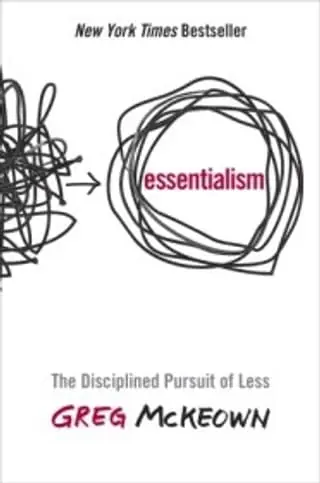
Essentialism summary
by Greg McKeown · 2014 · 7 key ideas · 16-minute read
Do less but better: deliberately choose the few things that truly matter, eliminate the rest, and make executing the essential as easy as possible.
Why read it
For capable people who say yes to too much and feel stretched thin. It gives you permission and practical tools to say no, trade off and focus.
Essentialism in brief
McKeown describes two ways of living. The Nonessentialist thinks everything is important, says yes to almost everything and ends up making a millimetre of progress in a thousand directions. The Essentialist believes only a few things truly matter, discerns what they are, and gives them full energy. His motto, borrowed from designer Dieter Rams, is 'less but better'.
The core of Essentialism rests on three truths: you have a choice about how to spend your energy; almost everything is noise, and a very few things are exceptionally valuable; and you cannot have it all, so trade-offs are unavoidable. If you don't prioritise your life, he warns, someone else will.
The book then follows a three-step process. Explore: create space to think, look, play and sleep, then apply strict criteria to choose. Eliminate: clarify your essential intent, say no gracefully, cut losses and set boundaries. Execute: build buffers, remove obstacles, celebrate small wins and design routines so the essential happens almost automatically.
The goal isn't to do more in less time, or just to do less. It is to make the highest possible contribution by investing in the right things, and to feel in control of your choices rather than at the mercy of others' priorities.
The 7 key ideas
1. Less but better
If you don't prioritise your life, someone else will.
2. The paradox of success
Success can be a catalyst for failure if you stop choosing.
3. Trade-offs are unavoidable
Not 'how can I do it all?' but 'which problem do I want?'
4. Create space to explore
To find the vital few, first make room to look.
5. The 90 percent rule
If it isn't a hell yes, it's a no.
6. The graceful no
A clear no today beats a resentful yes tomorrow.
7. Make execution effortless
Design it so the right thing is the easy thing.
Read the full guide in Kinquire. Every idea with a real example, a diagram and one thing to try today, plus a quick quiz so it sticks. Free to start.
Read EssentialismKey takeaways
- Name your few true priorities and use them as filters.
- Use the 90 percent rule: anything less than a clear yes is a no.
- Practise graceful no scripts so declining becomes easier.
- Schedule unbooked time to think and protect your sleep.
- Add 50% buffers to estimates and remove your biggest bottleneck.
Our take
Essentialism is clear, warm and genuinely useful; its tools, like the 90 percent rule and graceful no, are easy to remember and apply. Its blind spot is privilege: saying no and protecting space are much easier for senior professionals than for junior staff, carers or people in precarious jobs. Some stories are familiar from other business books, and the message is repeated at length. But as a corrective to the cult of busyness and the pressure to say yes, it has held up well.
About Greg McKeown
Greg McKeown is a British-born author, speaker and leadership consultant based in the United States. He later wrote a follow-up, Effortless, and hosts a podcast.
If you liked this
- Effortless by Greg McKeown
- The ONE Thing by Gary Keller and Jay Papasan
- Deep Work by Cal Newport
- Four Thousand Weeks by Oliver Burkeman
- Atomic Habits by James Clear
- The Power of Habit by Charles Duhigg