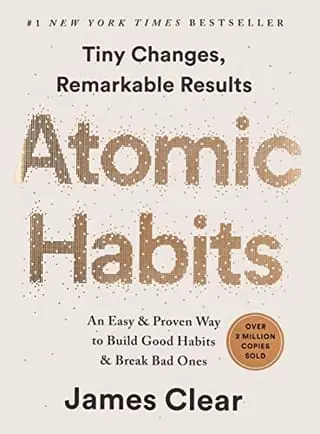
Atomic Habits summary
by James Clear · 2018 · 7 key ideas · 20-minute read
Tiny changes, repeated daily and built into your surroundings, compound into remarkable results — so fix your systems, not your willpower.
Why read it
For anyone who keeps setting goals and keeps slipping back into old routines. It turns habit science into a practical toolkit you can use the same day.
Atomic Habits in brief
Clear's starting point is that real change rarely comes from one dramatic decision. It comes from small habits that compound. Getting one percent better each day barely shows at first, but over a year it adds up enormously — and one percent worse adds up just as fast in the other direction. Because results lag behind effort, most people quit in the frustrating stretch before progress becomes visible.
He argues that goals are less useful than the systems that produce results. Winners and losers often share the same goals; what differs is the daily process. The deepest level of change is identity: lasting habits come from deciding who you want to be and letting each small action serve as proof of it.
The core of the book is a four-step model of how habits work — cue, craving, response, reward — and four matching laws for building good habits: make them obvious, attractive, easy and satisfying. Flip each law and you get a method for breaking bad ones: make them invisible, unattractive, difficult and unsatisfying.
Along the way Clear offers concrete tactics: implementation intentions, habit stacking, redesigning your environment, the two-minute rule, temptation bundling and habit tracking. He closes by noting that habits are a foundation, not a ceiling: to reach mastery you must pair automatic habits with deliberate practice and keep reviewing whether they still serve you.
The 7 key ideas
1. Small gains compound
Results lag behind habits. Keep going through the quiet part.
2. Systems beat goals
You don't rise to your goals — you fall to your systems.
3. Every action is a vote for who you are
Every rep is a ballot. Win the majority, not unanimity.
4. The habit loop and the four laws
Obvious, attractive, easy, satisfying — or the reverse to break it.
5. Make it obvious: design your space
Be the architect of your space, not its victim.
6. Make it easy: the two-minute rule
Master showing up first. Optimise later.
7. Make it satisfying: never miss twice
Missing once is an accident. Missing twice is a new habit.
Read the full guide in Kinquire. Every idea with a real example, a diagram and one thing to try today, plus a quick quiz so it sticks. Free to start.
Read Atomic HabitsKey takeaways
- Rewrite one goal as a daily system you can run without thinking about the outcome.
- Decide who you want to be, then treat each small action as a vote for that identity.
- Use 'After I ___, I will ___' to attach a new habit to an existing one.
- Shrink new habits to a two-minute version until showing up is automatic.
- Move cues for good habits into sight and hide the cues for bad ones.
- Track your habits visibly, and if you miss a day, never miss twice.
Our take
Atomic Habits is a superb synthesis: clear, practical and easy to apply, and its focus on environment and identity matches much of what habit researchers find. Its blind spots are those of most habit books. Much of the framework is borrowed from Fogg, Duhigg and behavioural science, and it is presented more confidently than the evidence always allows. The compounding maths is a metaphor, some stories are simplified, and it says little about structural limits like poverty, illness or caregiving that make 'just redesign your environment' harder for some. As a field guide to starting and keeping habits, it has held up very well.
About James Clear
James Clear is an American writer whose popular newsletter on habits and continuous improvement grew into this book, his first, which became one of the best-selling self-help books of its decade.
If you liked this
- The Power of Habit by Charles Duhigg
- Tiny Habits by BJ Fogg
- Mindset by Carol S. Dweck
- The 7 Habits of Highly Effective People by Stephen R. Covey
- Grit by Angela Duckworth
- Can't Hurt Me by David Goggins