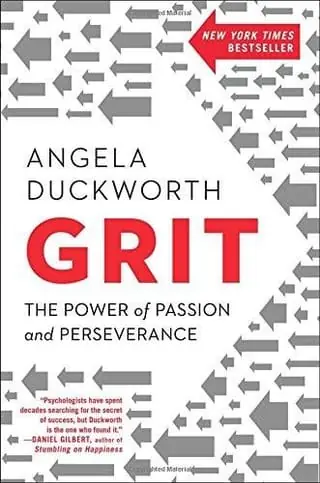
Grit summary
by Angela Duckworth · 2016 · 8 key ideas · 21-minute read
Long-term achievement depends less on talent than on grit — a combination of passion and perseverance for goals that matter to you.
Why read it
For anyone who starts things with enthusiasm and struggles to stick with them, and for parents, teachers and managers who want to help others keep going.
Grit in brief
Duckworth began her research puzzled by why some people with obvious talent fall short while others with less natural ability go further. Studying cadets at West Point, spelling bee contestants, salespeople and students, she found that a quality she calls grit — sustained passion and perseverance toward long-term goals — often predicted who would succeed better than measures of talent.
Part of the reason is that effort counts twice. Talent is how quickly skill improves with effort; achievement is what happens when you keep applying effort to that skill. Gritty people are not just hard workers in the moment; they stay loyal to the same top-level goal for years, organising their smaller goals beneath it.
Duckworth argues that grit can grow 'from the inside out' through four psychological assets: interest that is discovered and deepened over time, the capacity for deliberate practice, a sense of purpose that connects work to others, and hope — the belief that your own efforts can improve your future.
Grit can also grow 'from the outside in'. Parents who are both supportive and demanding, extracurricular activities that require sustained commitment, and cultures that expect people to keep going all help. The book closes with a reminder that grit is not everything — but it is something we can cultivate.
The 8 key ideas
1. Grit outlasts talent
Talent starts the race. Grit finishes it.
2. Effort counts twice
Effort counts twice.
3. One top goal, many paths
Stubborn about the summit, flexible about the path.
4. Passion is grown, not found
Don't find your passion. Grow it.
5. Practise deliberately
Not more hours — better hours.
6. Purpose fuels persistence
Same bricks. Different building.
7. Hope that you can improve
Not 'always' and 'everything' — 'this time' and 'this task'.
8. Grit grows from the outside in
Support and stretch: high warmth, high standards.
Read the full guide in Kinquire. Every idea with a real example, a diagram and one thing to try today, plus a quick quiz so it sticks. Free to start.
Read GritKey takeaways
- Write down a single top-level goal and prune goals that don't serve it.
- Remember that effort counts twice — track focused hours, not talent.
- Grow interests by revisiting them, rather than waiting for a spark.
- Use deliberate practice: stretch goal, full focus, fast feedback, reflection.
- Reframe setbacks as temporary and specific to keep hope alive.
- Choose a 'hard thing' and commit to a natural stopping point before quitting.
Our take
Grit captured something real: persistence and sustained interest matter, and talent alone doesn't guarantee success. The ideas on goal hierarchies, deliberate practice and purpose are practical and well grounded. But the concept has been criticised. A large meta-analysis found grit is closely related to conscientiousness and predicts performance only modestly, while the 'passion' component adds little. Critics also worry that emphasising individual grit can distract from structural barriers like poverty or bad schools, and that sticking with the wrong goal can be costly. Duckworth acknowledges grit isn't the only thing that matters. Read as one useful ingredient rather than the secret of success, the book holds up well.
About Angela Duckworth
Angela Duckworth is a psychologist at the University of Pennsylvania and a former schoolteacher; she received a MacArthur Fellowship for her research on grit and self-control.
If you liked this
- Mindset by Carol S. Dweck
- So Good They Can't Ignore You by Cal Newport
- Atomic Habits by James Clear
- The Power of Habit by Charles Duhigg
- The 7 Habits of Highly Effective People by Stephen R. Covey
- Can't Hurt Me by David Goggins