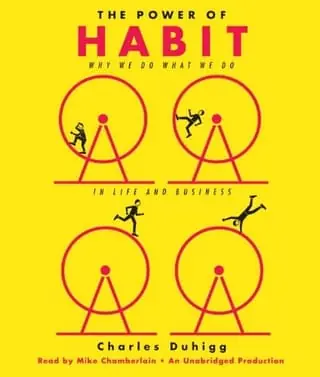
The Power of Habit summary
by Charles Duhigg · 2012 · 7 key ideas · 20-minute read
Habits run on a simple loop of cue, routine and reward — and once you can see the loop, you can rewire it in yourself, your company and your community.
Why read it
For anyone curious why bad habits are so stubborn and how businesses, teams and movements deliberately shape behaviour. It mixes neuroscience with gripping real stories.
The Power of Habit in brief
Duhigg argues that a huge share of what we do each day is not decided but automatic. Habits form because the brain is always looking for ways to save effort: it turns repeated sequences into chunks that run with little conscious thought. That makes us efficient — and it means habits persist long after we've stopped choosing them.
Every habit, he says, follows a three-part loop: a cue that triggers it, a routine that is the behaviour itself, and a reward that tells the brain the loop is worth remembering. What gives the loop its grip is craving: over time the brain begins to anticipate the reward as soon as it sees the cue. Advertisers and product designers have learned to engineer exactly this.
You rarely erase a habit, but you can change it. Duhigg's Golden Rule is to keep the old cue and reward and insert a new routine — and, for change to last under stress, to add belief, which often comes from a group. Some habits matter more than others: 'keystone habits' trigger chain reactions that reshape whole lives and organisations.
The later parts widen the lens. Willpower can be trained like a habit; companies run on institutional habits that can be disastrous or transformative; social movements spread through habits of friendship and community. Duhigg ends with a practical framework and an argument that once we know a habit exists, we are responsible for changing it.
The 7 key ideas
1. The brain loves autopilot
Habits are decisions your brain stopped making.
2. Cue, routine, reward
See the cue, name the reward, and the routine is yours to change.
3. Craving drives the loop
No craving, no habit.
4. The Golden Rule of change
Same cue, same reward, new routine — plus a group that believes.
5. Keystone habits
Pull the right thread and the whole pattern shifts.
6. Willpower can be trained
Decide when you're calm, so you don't have to when you're tempted.
7. Run your own experiment
Location, time, mood, people, last action — one of them is your cue.
Read the full guide in Kinquire. Every idea with a real example, a diagram and one thing to try today, plus a quick quiz so it sticks. Free to start.
Read The Power of HabitKey takeaways
- Map one bad habit into cue, routine and reward before trying to change it.
- Test different routines to discover which reward you really crave.
- Keep the cue and reward, but plan a new routine for when the cue fires.
- Find a group or partner who believes change is possible to carry you through stressful moments.
- Pick one keystone habit and protect it; watch for knock-on effects.
- Plan in advance for the predictable moments when your willpower usually fails.
Our take
The Power of Habit popularised the habit loop and remains one of the most readable introductions to the subject. Its strength is storytelling: Alcoa, Febreze and Eugene Pauly make abstract science vivid. The weaknesses are typical of narrative non-fiction. Some stories are tidied up to fit the model, and causal claims (a keystone habit 'caused' a company's turnaround) are hard to prove. The willpower chapter leans on ego-depletion research that has not replicated well. Later, more research-based books such as Wendy Wood's Good Habits, Bad Habits refine the picture, but the core loop and the 'keep the cue, swap the routine' advice have held up well.
About Charles Duhigg
Charles Duhigg is an American journalist who reported for The New York Times and shared a Pulitzer Prize for explanatory reporting. This was his first book.
If you liked this
- Atomic Habits by James Clear
- Tiny Habits by BJ Fogg
- The 7 Habits of Highly Effective People by Stephen R. Covey
- Mindset by Carol S. Dweck
- Grit by Angela Duckworth
- Can't Hurt Me by David Goggins