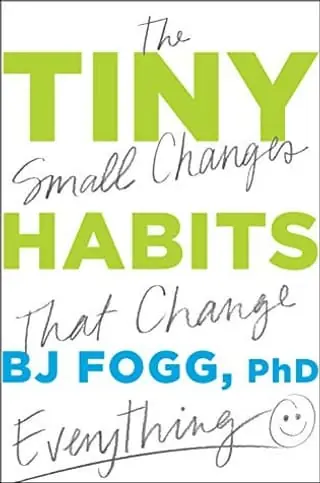
Tiny Habits summary
by BJ Fogg · 2019 · 7 key ideas · 17-minute read
Forget willpower: make new habits ridiculously small, attach them to something you already do, and celebrate immediately so they wire in.
Why read it
For anyone who has tried and failed to build habits through motivation and discipline. It offers a gentle, systematic method that works even on your worst days.
Tiny Habits in brief
Fogg argues that most attempts to change fail not because people are weak but because they use the wrong method. Relying on motivation is like relying on the weather. Instead, he offers a simple model: a behaviour happens when motivation, ability and a prompt come together at the same moment — B = MAP.
Since motivation is unreliable, the dependable levers are ability and prompts. Make the behaviour so small it requires almost no motivation — floss one tooth, do two push-ups — and link it to a moment already in your day, using a recipe: 'After I…, I will…'. Then celebrate right away to create a positive feeling that wires the habit in.
Fogg's central claim is that emotions, not repetition, create habits. A small burst of positive feeling — what he calls 'Shine' — tells your brain that this behaviour matters. Tiny habits that feel good tend to grow naturally into bigger ones and spread to other areas of life.
The book also covers how to choose which habits to work on, how to troubleshoot when something doesn't stick, and how to untangle unwanted habits by removing prompts and adding friction. Its underlying message is self-compassion: change best by feeling good, not by feeling bad.
The 7 key ideas
1. B = MAP
No prompt, no behaviour.
2. Don't trust motivation
Design for your laziest day, not your best.
3. Start tiny
Tiny is mighty.
4. Find the right anchor
Hitch the new to the old.
5. Celebrate to wire it in
Feel good, and the habit grows.
6. Pick golden behaviours
Match yourself to the habit — don't fight yourself into it.
7. Untangle bad habits
Prompt, then ability, then motivation.
Read the full guide in Kinquire. Every idea with a real example, a diagram and one thing to try today, plus a quick quiz so it sticks. Free to start.
Read Tiny HabitsKey takeaways
- Diagnose any missing behaviour with B = MAP: prompt first, then ability, then motivation.
- Shrink each new habit to a version that takes under thirty seconds.
- Attach habits to reliable routines with 'After I…, I will…'.
- Celebrate immediately after every tiny habit to wire it in.
- Choose golden behaviours that are effective, wanted and doable.
- To stop a habit, remove the prompt and add friction before relying on willpower.
Our take
Tiny Habits is a humane, practical guide: its 'start tiny, anchor, celebrate' method is easy to try and its focus on self-compassion is a welcome contrast to discipline-heavy books. The B = MAP model is a genuinely useful diagnostic tool. Its evidence is mostly drawn from Fogg's own coaching programmes and participants' experiences rather than controlled studies, and some claims — particularly that emotion, not repetition, forms habits — go beyond what research has established. Readers may find celebration awkward, and the method suits building small routines better than tackling deep problems like addiction. Much of it overlaps with Atomic Habits, which credits Fogg for ideas like habit stacking.
About BJ Fogg
BJ Fogg is a behaviour scientist at Stanford University, where he founded the Behavior Design Lab; his work on behaviour and technology has influenced many product designers.
If you liked this
- Atomic Habits by James Clear
- The Power of Habit by Charles Duhigg
- The 7 Habits of Highly Effective People by Stephen R. Covey
- Mindset by Carol S. Dweck
- Grit by Angela Duckworth
- Can't Hurt Me by David Goggins