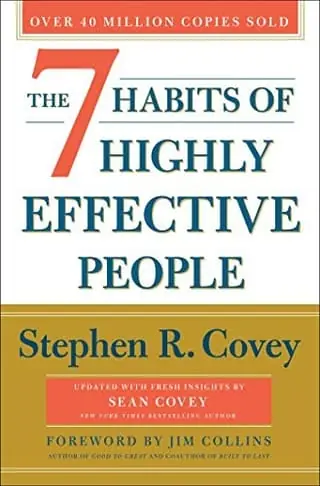
The 7 Habits of Highly Effective People summary
by Stephen R. Covey · 1989 · 8 key ideas · 21-minute read
Lasting effectiveness comes from character, not techniques: master yourself first, then work with others, then keep renewing both.
Why read it
For anyone who feels busy but not effective, or whose relationships keep running into the same walls. It offers a complete, principle-based operating system for life and work.
The 7 Habits of Highly Effective People in brief
Covey argues that much modern success advice teaches a 'personality ethic' — quick techniques, image and positive thinking. He calls for a return to the 'character ethic': timeless principles such as fairness, integrity and service. To change results, you must first change your paradigms, the mental maps through which you see the world.
The seven habits follow a 'maturity continuum' from dependence (you take care of me) to independence (I can do it myself) to interdependence (we can do it better together). Habits 1–3 — be proactive, begin with the end in mind, put first things first — are the 'private victory' of self-mastery that leads to independence.
Habits 4–6 — think win-win, seek first to understand then to be understood, and synergize — are the 'public victory' of working with others. Covey insists the order matters: you cannot build trusting relationships on a foundation of weak character, because trust is earned through consistent, kept commitments.
Habit 7, sharpen the saw, is about renewing yourself in four dimensions — physical, mental, social-emotional and spiritual — so the other habits keep working. Throughout, Covey balances production with production capability: results matter, but so does caring for the people and assets that produce them.
The 8 key ideas
1. Change the lens, not the behaviour
Change the map and the journey changes.
2. Be proactive
Response-ability: you can't pick the weather, but you pick your coat.
3. Begin with the end in mind
Everything is built twice: first in the mind, then in the world.
4. Put first things first
If it's important but not urgent, schedule it — or it never happens.
5. Think win-win
Win-win, or no deal.
6. Seek first to understand
Diagnose before you prescribe.
7. Synergize
Not your way, not my way — a better way.
8. Sharpen the saw
Stop sawing long enough to sharpen the saw.
Read the full guide in Kinquire. Every idea with a real example, a diagram and one thing to try today, plus a quick quiz so it sticks. Free to start.
Read The 7 Habits of Highly Effective PeopleKey takeaways
- Notice reactive language and reframe it as a choice you're making.
- Write a short personal mission statement and revisit it monthly.
- Plan each week by scheduling important, non-urgent tasks first.
- Before you argue your case, summarise the other person's view until they agree.
- When stuck between two options, search together for a third alternative.
- Protect daily time for physical, mental, social and spiritual renewal.
Our take
The 7 Habits endures because it offers a coherent framework rather than isolated tips: the order of habits, from self-mastery to collaboration to renewal, is genuinely useful. Its ideas on proactivity, prioritising important work and empathic listening have entered everyday business language. Critics find it long, earnest and occasionally preachy, with examples that feel dated and corporate. Many anecdotes are personal and unverifiable, and its principles are presented as timeless truths rather than tested claims. Some readers find it light on the structural limits people face. Still, its core advice has held up remarkably well and overlaps with much later work on habits, priorities and communication.
About Stephen R. Covey
Stephen R. Covey (1932–2012) was an American educator and consultant who taught at Brigham Young University and co-founded the training company that became FranklinCovey.
If you liked this
- Man's Search for Meaning by Viktor E. Frankl
- How to Win Friends and Influence People by Dale Carnegie
- Deep Work by Cal Newport
- Atomic Habits by James Clear
- The Power of Habit by Charles Duhigg
- Mindset by Carol S. Dweck