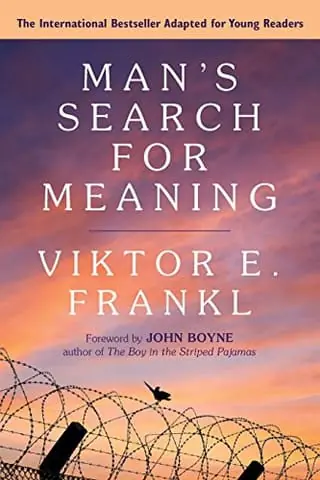
Man's Search for Meaning summary
by Viktor E. Frankl · 1946 · 8 key ideas · 24-minute read
A psychiatrist who survived the Nazi camps argues that the deepest human drive is not pleasure or power but meaning, and that we keep the freedom to choose our attitude even when everything else is taken.
Why read it
For anyone facing loss, pressure or a quiet sense of emptiness: it is short, unforgettable, and gives a practical way to think about suffering and purpose.
Man's Search for Meaning in brief
The book has two parts. The first is Frankl's account of life as a prisoner in the Nazi camps between 1942 and 1945. He does not tell it as a history of atrocities but as a psychologist's question: how did ordinary people respond inwardly to extreme suffering, and why did some keep their humanity while others lost it?
He describes the stages prisoners went through: the shock of arrival, the numb apathy that protected them from daily horror, and the strange disorientation after liberation. Through it all he noticed that those who had something to live for — a loved one, a task, a future work — seemed better able to endure. Hope and meaning were not luxuries; they were a form of resistance.
His central observation is that everything can be taken from a person except one thing: the freedom to choose one's attitude in any given set of circumstances. Even in the camps, some people comforted others and gave away their last piece of bread. Suffering did not decide who you became; your response did.
The second part, 'Logotherapy in a Nutshell', turns those experiences into a theory. Frankl argues that the primary human motivation is a will to meaning. Meaning cannot be handed to us; it is discovered in three ways — through work or deeds, through love and experience, and through the attitude we take toward unavoidable suffering.
Later editions add an essay on 'tragic optimism': the claim that people can say yes to life despite pain, guilt and death. The book's message is demanding but hopeful. Life is not about what we expect from it, Frankl says, but about what it expects from us — and we answer through our actions.
The 8 key ideas
1. The last human freedom
They can take everything but your answer.
2. A why to bear any how
Find the why and the how gets lighter.
3. Three paths to meaning
Do, love, endure — one door is always open.
4. Love as an inner refuge
Love travels where you can't.
5. Ask what life asks of you
Life asks the questions; your actions are the answers.
6. The existential vacuum
Emptiness isn't cured by more; it's cured by for.
7. Happiness must ensue
Aim past happiness; it'll meet you on the way.
8. Tragic optimism
Pain, guilt, death — each can be turned into meaning.
Read the full guide in Kinquire. Every idea with a real example, a diagram and one thing to try today, plus a quick quiz so it sticks. Free to start.
Read Man's Search for MeaningKey takeaways
- In any setback, separate what you can't control from the one thing you can: your response.
- Keep a written list of your 'whys' — people, work and experiences that need you.
- Use all three paths to meaning: create something, love someone, face hardship with courage.
- When life feels empty, ask what the moment asks of you, then act on it.
- Stop chasing happiness directly; commit to a cause or person and let it follow.
- Treat regrets as instructions for change, not sentences to serve.
Our take
Few books have done more to persuade readers that meaning is a psychological necessity, and its central insight — that attitude remains a choice even under extreme pressure — has held up as a source of strength for millions. Its limits are worth knowing. Frankl's survival depended heavily on luck, as he admits, and some historians have noted he spent only a few days at Auschwitz itself before being moved to Dachau subcamps, so the account is a personal, not representative, history. Logotherapy has a thinner research base than mainstream therapies. And the message can be misused to imply victims simply lacked the right attitude, which Frankl did not believe.
About Viktor E. Frankl
Viktor Frankl (1905–1997) was a Viennese psychiatrist and neurologist who survived several Nazi concentration camps, including Auschwitz and subcamps of Dachau. He founded logotherapy, often called the 'third Viennese school' of psychotherapy after Freud and Adler.
If you liked this
- Meditations by Marcus Aurelius
- The Myth of Sisyphus by Albert Camus
- Ikigai by Héctor García and Francesc Miralles
- The Book of Joy by Dalai Lama, Desmond Tutu and Douglas Abrams
- Letters from a Stoic by Seneca
- The Enchiridion by Epictetus