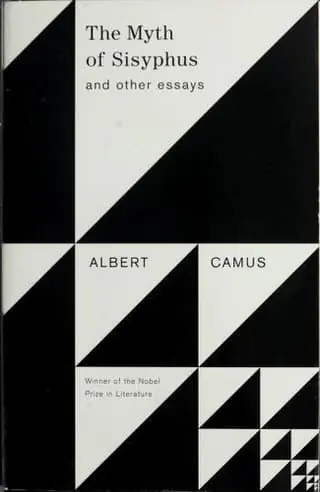
The Myth of Sisyphus summary
by Albert Camus · 1942 · 7 key ideas · 20-minute read
If life has no built-in meaning, should we despair? Camus argues no: we can face the absurd with open eyes and live all the more fully because of it.
Why read it
For anyone who has felt the sudden “why am I doing all this?” and wants an honest, ultimately life-affirming answer that doesn't depend on comforting illusions.
The Myth of Sisyphus in brief
Camus begins with a startling claim: the one truly serious philosophical question is whether life is worth living. Everything else, he says, comes after. His aim is not to recommend despair but to see whether a person can live honestly without the comforting belief that life has a meaning built into it.
He describes the absurd. Human beings long for clarity, unity and meaning; the world offers silence. The absurd is not in us or in the world alone, but in the clash between the two. It often arrives suddenly, when the familiar routine of daily life collapses into the simple question: why?
Camus then rejects two escapes. One is physical suicide, which surrenders to the absurd. The other is what he calls philosophical suicide: taking a leap of faith into God or a grand system that dissolves the absurd by explaining it away. He criticises several existentialist thinkers for making that leap. Instead he proposes living with the absurd: in revolt, in freedom and with passion.
He sketches examples of absurd lives, such as the seducer, the actor, the conqueror and the artist, and ends with the Greek myth of Sisyphus, condemned to push a rock uphill forever. Camus finds in him a hero: fully conscious of his fate, scornful of the gods, and committed to his task. His famous conclusion is that we must imagine Sisyphus happy.
The 7 key ideas
1. The one serious question
The first question: is it worth it? Camus's answer: yes, with open eyes.
2. Where the absurd comes from
The absurd lives in the gap between our questions and the world's silence.
3. No leaps of faith
Don't leap. Stand where you are and look.
4. Revolt: keep your eyes open
See it clearly. Say yes anyway.
5. Freedom without a script
No script means you're free to stop performing someone else's.
6. Live the most, not the best
Not the best life. The most life, eyes open.
7. Imagine Sisyphus happy
The rock is yours. One must imagine Sisyphus happy.
Read the full guide in Kinquire. Every idea with a real example, a diagram and one thing to try today, plus a quick quiz so it sticks. Free to start.
Read The Myth of SisyphusKey takeaways
- When the “why?” arrives, sit with it instead of rushing to distract yourself.
- Notice which of your beliefs are knowledge and which are hope.
- Respond to life's limits with lucid defiance, not surrender.
- Drop goals you follow only because they're the next step on someone else's script.
- Bring full attention to repetitive tasks and make them your own.
Our take
The Myth of Sisyphus is a passionate, honest attempt to affirm life without religious or metaphysical guarantees, and its images, from the commuter's sudden “why” to Sisyphus walking down the hill, are unforgettable. Its strengths are emotional and existential rather than logical. Philosophers often find its arguments loose: why exactly does the absurd demand revolt rather than, say, indifference? Its readings of other thinkers can be one-sided, and its heroes are strikingly individualistic. Camus himself later broadened his ethics toward solidarity in The Rebel. Still, for readers wrestling with meaning, it remains one of the most bracing and humane answers available.
About Albert Camus
Albert Camus was a French writer and thinker, born in 1913 in Algeria, then under French rule. His novel The Stranger appeared in the same year as this essay, and he received the Nobel Prize in Literature in 1957.
If you liked this
- Man's Search for Meaning by Viktor E. Frankl
- Beyond Good and Evil by Friedrich Nietzsche
- The Consolations of Philosophy by Alain de Botton
- Meditations by Marcus Aurelius
- Letters from a Stoic by Seneca
- The Enchiridion by Epictetus