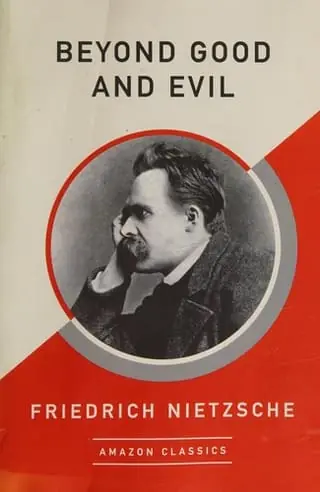
Beyond Good and Evil summary
by Friedrich Nietzsche · 1886 · 8 key ideas · 21-minute read
A provocative attack on the hidden assumptions of philosophy and morality, urging free spirits to question where our values come from and to create better ones.
Why read it
For readers who want their deepest assumptions about truth, morality and the self challenged hard. Nietzsche is unsettling and sometimes offensive, but few writers teach you to question so sharply.
Beyond Good and Evil in brief
Beyond Good and Evil, subtitled Prelude to a Philosophy of the Future, is written in short numbered sections and aphorisms grouped into nine parts. It is less a system than a series of raids on the beliefs that philosophers, scientists and moralists take for granted.
Nietzsche begins with philosophers themselves. They claim to follow pure reason, he says, but really defend prejudices and moral wishes after the fact. Even the will to truth is questioned: why do we prefer truth to untruth, and what does that preference serve? Our grammar, too, tricks us, for example into assuming a thinking “I” behind every thought.
He proposes that life itself is, at bottom, will to power: a drive to grow, expand and express strength, of which self-preservation is just one consequence. From this angle he examines religion and morality. Modern European morality, he argues, is herd morality, rooted in fear and in the needs of the weak. He contrasts master morality, which calls the noble and strong good, with slave morality, which calls the powerful evil and praises meekness.
The book's hope is for new philosophers, free spirits willing to stand outside inherited values, take responsibility for creating new ones and accept the risks. The tone is ironic, aristocratic and deliberately provocative, and the book contains passages, especially on women and on democracy, that many readers find repugnant. Translations differ, and much depends on interpretation.
The 8 key ideas
1. Every philosophy is a confession
Behind every theory, ask: who needed to believe this?
2. Question the will to truth
Ask not only “is it true?” but “what does believing it do?”
3. Grammar fools us
A thought comes when it wants, not when I want.
4. Life as will to power
Life wants more than survival. It wants to grow.
5. Master and slave morality
Every “good” has a history. Ask whose.
6. The herd and its fear
Not every “should” is ethics. Some are just the herd's fear.
7. Don't become the monster
Fight monsters, but check the mirror.
8. Philosophers who create values
Don't just inherit your values. Examine them, then own them.
Read the full guide in Kinquire. Every idea with a real example, a diagram and one thing to try today, plus a quick quiz so it sticks. Free to start.
Read Beyond Good and EvilKey takeaways
- Ask what wishes or interests lie behind your strongest beliefs.
- Treat thoughts as events that arrive, not commands from your true self.
- Notice when social conformity is dressed up as moral duty.
- In long fights, check regularly that you aren't becoming what you oppose.
- Examine your inherited values and consciously keep, revise or drop them.
Our take
Beyond Good and Evil is one of the most stimulating books in philosophy: it taught generations to question the motives behind beliefs, the influence of language, and the origins of morality. Its aphoristic style is brilliant but also slippery, allowing contradictory readings. Its elitism, its scorn for democracy and equality, and its passages on women are hard to defend, and its history of morals is speculative. Its later misuse by the Nazis, aided by his sister's editing of other material, is a distortion scholars reject, but his language of power invites misreading. Read it as a whetstone for thinking, not a manual for living, and compare translations.
About Friedrich Nietzsche
Friedrich Nietzsche was a German philosopher who became a professor of classical philology at Basel while still in his twenties. He suffered a mental collapse in 1889 and wrote nothing more after it.
If you liked this
- The Myth of Sisyphus by Albert Camus
- The Consolations of Philosophy by Alain de Botton
- Meditations by Marcus Aurelius
- Letters from a Stoic by Seneca
- The Enchiridion by Epictetus
- The Obstacle Is the Way by Ryan Holiday