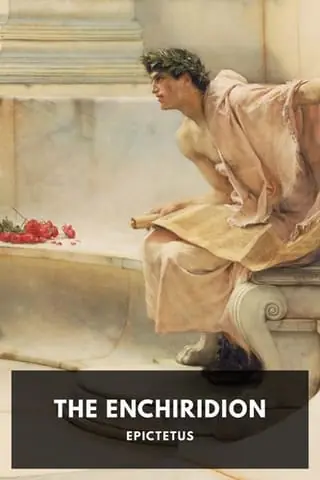
The Enchiridion summary
by Epictetus · 125 · 8 key ideas · 21-minute read
A pocket manual of Stoic practice built on one idea: sort what is up to you from what isn't, and stake your peace only on the first.
Why read it
For anyone who wants Stoicism in its most compact, practical form. It is short enough to read in an hour and useful enough to reread for a lifetime.
The Enchiridion in brief
Enchiridion means something like “handbook” or “thing held in the hand.” It is a short collection of numbered sections, distilled by the historian Arrian from the longer Discourses he had recorded from his teacher Epictetus. It was meant to be carried and consulted, like a soldier's field manual for the mind.
The opening line sets everything up. Some things are up to us and some are not. Our opinions, intentions, desires and aversions are up to us. Our bodies, possessions, reputations and positions are not. Suffering comes from attaching our happiness to the second group and trying to control what we cannot.
The rest of the book trains this distinction through vivid, practical exercises. Remind yourself that loved things are fragile. Expect friction before you go out. Take what life offers at its banquet without grabbing. Accept that every prize has a price you may choose not to pay. Play the role you've been given as well as you can, whatever it is.
The tone is blunt and demanding, but the promise is generous: no one can harm the part of you that judges and chooses. If you guard that, you can be free even in difficult circumstances. Coming from a man who had been enslaved, this was not a theory but a hard-won survival skill.
The 8 key ideas
1. Up to you, or not up to you
Ask first: is this up to me? If not, let it go.
2. Judgments, not things, disturb you
It's not the thing. It's what you think about the thing.
3. Start with the jug
Love the jug. Know it's a jug.
4. Say “I gave it back”
Nothing is lost, only returned. Look after it like a guest.
5. Expect the splashing at the baths
Came for a bath and calm. Don't trade the calm for a splash.
6. Behave as at a banquet
Take politely, let pass gracefully, wait patiently.
7. Everything has a price
No coin, no lettuce. But you still have your coin.
8. Play your part well
You don't write the script. You decide how well you act it.
Read the full guide in Kinquire. Every idea with a real example, a diagram and one thing to try today, plus a quick quiz so it sticks. Free to start.
Read The EnchiridionKey takeaways
- Sort each worry into “up to me” and “not up to me”, and act only on the first.
- When upset, look for the judgment behind the feeling.
- Practise on small losses so larger ones don't overwhelm you.
- Before outings, picture the likely annoyances and set a goal to stay composed.
- Before envying someone, ask what price they paid and whether you'd pay it.
- Play your current role as well as you can, whatever it is.
Our take
The Enchiridion is unmatched as a compact, practical guide: its control distinction and its reframing of judgments are both simple and powerful, and they anticipate much of modern cognitive therapy. Its weaknesses come from that same compression. Without the fuller arguments of the Discourses, some advice sounds harsh, especially on detachment from loved ones. Its acceptance of one's assigned role can read as resignation in the face of injustice, a concern critics raise about Stoicism generally. And its picture of a providential universe will not convince everyone. Translations range from old-fashioned to very modern, which changes the feel considerably.
About Epictetus
Epictetus was born a slave in the first century AD, later gained his freedom and taught Stoic philosophy, eventually at Nicopolis in Greece. He wrote nothing himself; his student Arrian recorded his teaching, and the Enchiridion is Arrian's short handbook of it.
If you liked this
- Meditations by Marcus Aurelius
- Letters from a Stoic by Seneca
- Man's Search for Meaning by Viktor E. Frankl
- The Obstacle Is the Way by Ryan Holiday
- Ego Is the Enemy by Ryan Holiday
- The Art of War by Sun Tzu