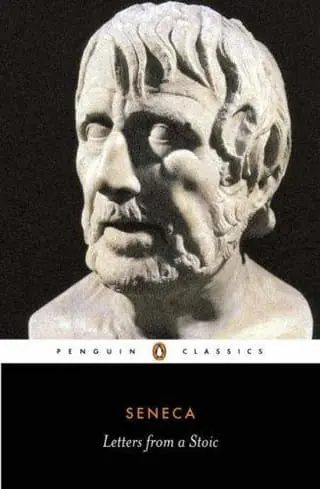
Letters from a Stoic summary
by Seneca · 65 · 7 key ideas · 20-minute read
An ageing Roman statesman writes to a younger friend about how to use time well, master fear, and live a good life before it runs out.
Why read it
For anyone who feels busy but not fulfilled. Seneca is warm, witty and practical, and his advice on time, anxiety, reading and money feels startlingly modern.
Letters from a Stoic in brief
In the last years of his life, after stepping back from Nero's court, Seneca wrote a long series of letters to his friend Lucilius, a Roman official. The full collection has 124 letters; popular editions such as Letters from a Stoic offer a selection. They read like a mentor's correspondence: short, personal, often starting from something that happened that day and turning it into a lesson.
The first theme is time. Seneca argues that time is the only thing truly ours, yet we let others take it, waste it or let it slip by unnoticed. Philosophy, for him, is not an academic subject but a way of reclaiming your life: reading a few good books deeply, avoiding crowds that coarsen you, and examining yourself honestly.
The second theme is fear. Seneca notices that we suffer more in imagination than in reality, and he offers practical drills: rehearse hardship by living simply for a few days, picture losses in advance, and remember that death is a natural part of life, not an enemy waiting at the end.
Throughout, he insists that a good life depends on character rather than circumstance. Travel will not cure an unsettled mind; wealth will not secure happiness; old age is not a curse. Each letter usually ends with a small gift, a short saying to carry through the day, often borrowed from the rival school of Epicurus. The overall effect is a friendly, demanding invitation to start living properly now, not someday.
The 7 key ideas
1. Claim back your time
Guard your hours like your money; they're worth far more.
2. Read deeply, not widely
Everywhere means nowhere. Put down roots with a few great minds.
3. We suffer more in imagination
Don't pay today for troubles that may never arrive.
4. Practise poverty
Taste a little hardship now, and big fears shrink.
5. Beware the crowd
You become the room you sit in.
6. You take yourself everywhere
Wherever you go, there you are. Fix the passenger, not the destination.
7. Live each day as a complete life
Close each day as if it were the last chapter. Tomorrow is a bonus.
Read the full guide in Kinquire. Every idea with a real example, a diagram and one thing to try today, plus a quick quiz so it sticks. Free to start.
Read Letters from a StoicKey takeaways
- Track where your hours go for a few days, and reclaim one block.
- Choose a few great books and read them slowly, one idea at a time.
- Check each big worry against the evidence before you let it run your day.
- Spend one day a month living very simply to shrink your fear of loss.
- Spend more time with people who make you better.
- End each day by asking whether you truly lived it.
Our take
Seneca is perhaps the most readable ancient philosopher: vivid, personal and full of practical drills that still work. His advice on time, anxiety and reading has aged remarkably well. The obvious criticism, made even in his own day, is hypocrisy. He praised simplicity while being one of the richest men in Rome, and he served Nero for years. He partly answers this by admitting he is still learning, not preaching from perfection. The letters can also repeat themselves, and some sections on physics or Roman customs feel dated. Selections differ from edition to edition, so you may meet different letters depending on the version you pick up.
About Seneca
Seneca was a Roman Stoic philosopher, playwright and statesman who served as tutor and adviser to the emperor Nero. In 65 AD he was ordered by Nero to take his own life.
If you liked this
- Meditations by Marcus Aurelius
- The Enchiridion by Epictetus
- Four Thousand Weeks by Oliver Burkeman
- The Obstacle Is the Way by Ryan Holiday
- Ego Is the Enemy by Ryan Holiday
- The Art of War by Sun Tzu