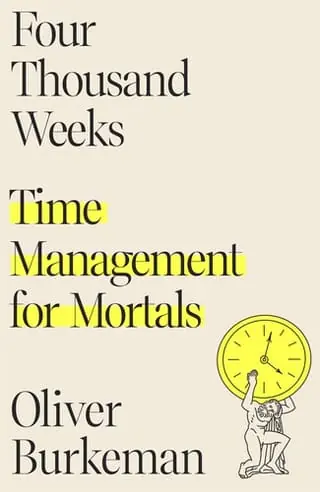
Four Thousand Weeks summary
by Oliver Burkeman · 2021 · 7 key ideas · 16-minute read
An average life lasts about four thousand weeks, so stop trying to get everything done and instead choose consciously what to neglect, and enjoy the time you have.
Why read it
For anyone exhausted by productivity advice who suspects that doing more, faster, isn't the answer. It's an anti-productivity book that is wise, funny and surprisingly practical.
Four Thousand Weeks in brief
If you live to eighty, you get roughly four thousand weeks. Burkeman starts from this uncomfortable fact and argues that most time-management advice makes things worse, because it promises a future in which, once you are efficient enough, you'll finally get on top of everything. That day will never come. There will always be more to do than you can do.
Our attempts to escape this truth create the problems they aim to solve. Becoming more efficient just brings more demands. Distraction often comes from inside: we flee hard tasks because they confront us with our limits. And we treat the present as only a means to a future that never quite arrives.
The alternative is to embrace finitude. Accept that you'll leave most things undone, and decide deliberately what to neglect. Limit how many projects you have in progress. Cultivate patience, because meaningful things take time. Do some things purely for their own sake, and recognise that time is also a shared resource, best enjoyed in sync with others.
The book ends with what Burkeman calls cosmic insignificance therapy: on the scale of the universe, your life barely registers, which is oddly freeing. You don't need to achieve something remarkable for your life to matter. You just need to spend your limited weeks on what you truly care about.
The 7 key ideas
1. You have about 4,000 weeks
You don't have time. You are time.
2. The efficiency trap
The inbox is infinite. Your life isn't.
3. Choose what to neglect
Your middling priorities are the real enemy.
4. Distraction comes from within
We flee into distraction to avoid our limits.
5. Stay on the bus
Stay on the bus long enough to reach somewhere new.
6. Rest and do things for their own sake
Rest isn't fuel for work. It's part of living.
7. Cosmic insignificance therapy
You don't have to matter to the universe to matter.
Read the full guide in Kinquire. Every idea with a real example, a diagram and one thing to try today, plus a quick quiz so it sticks. Free to start.
Read Four Thousand WeeksKey takeaways
- Accept that you'll never get everything done, and choose what to neglect.
- Limit active projects to about three, and finish before starting more.
- Pay yourself first: give your most important work the first block of time.
- When distracted, name the discomfort you're fleeing and stay with it briefly.
- Do something purely for its own sake each week, and protect shared time with others.
Our take
Four Thousand Weeks is a refreshing, humane counterweight to hustle culture, and its core diagnosis, that efficiency can't defeat infinite demands, rings true for many readers. Critics note that its philosophical framing is more inspiring than specific; readers wanting step-by-step systems may find the practical tools thin. Its advice to choose what to neglect is easier for people with some autonomy than for those whose time is controlled by employers or care duties. Still, its message has resonated widely and pairs well with more tactical books.
About Oliver Burkeman
Oliver Burkeman is a British journalist who for many years wrote a psychology column for The Guardian. He also wrote The Antidote, a book about happiness for people who dislike positive thinking.
If you liked this
- Slow Productivity by Cal Newport
- Essentialism by Greg McKeown
- Atomic Habits by James Clear
- The Power of Habit by Charles Duhigg
- The 7 Habits of Highly Effective People by Stephen R. Covey
- Mindset by Carol S. Dweck