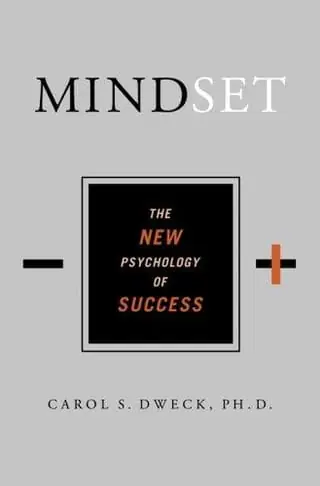
Mindset summary
by Carol S. Dweck · 2006 · 6 key ideas · 16-minute read
Whether you believe abilities are fixed or can grow shapes how you handle challenge, effort and failure — and that belief can be changed.
Why read it
For anyone who fears failure, avoids challenges or wants to raise, teach or lead people who keep learning. It names a pattern you'll start seeing everywhere.
Mindset in brief
Dweck's research points to two broad beliefs about ability. In a fixed mindset, intelligence and talent are carved in stone: you have a certain amount, and life is about proving it. In a growth mindset, abilities are a starting point that can be developed through effort, good strategies and help from others.
These beliefs change behaviour. People in a fixed mindset tend to avoid challenges, give up when things get hard, see effort as a sign of weakness and feel threatened by others' success. People in a growth mindset are more likely to seek challenges, persist through setbacks, value effort as the path to mastery and learn from criticism.
Dweck traces mindsets through sport, business, relationships, parenting and teaching. Coaches, CEOs, partners and parents can either reinforce the idea that people are fixed — through labels, talent worship and praise for being 'smart' — or nurture growth by focusing on process, effort and learning.
Most of us, she stresses, are a mix of both, and the fixed mindset is often triggered by specific situations. The book ends with practical ways to notice those triggers, talk back to them and gradually shift toward growth — while warning that growth mindset is not just praising effort or telling people to try harder.
The 6 key ideas
1. Two ways to see ability
Not 'I can't.' 'I can't yet.'
2. When everything is a test
Trying to look smart is the fastest way to stop getting smarter.
3. Praise the process, not the person
Praise the climb, not the height.
4. Talent is a starting point
Behind every natural is a lot of unnatural effort.
5. Fixed-mindset leaders
If you can't hear bad news, you can't fix it.
6. Growing out of a fixed mindset
Hear the voice. Answer it. Act anyway.
Read the full guide in Kinquire. Every idea with a real example, a diagram and one thing to try today, plus a quick quiz so it sticks. Free to start.
Read MindsetKey takeaways
- Add 'yet' to any 'I can't' statement about a skill.
- Praise effort, strategy and progress rather than talent or intelligence.
- Treat setbacks as information about your approach, not a verdict on you.
- Learn the backstory of people you admire to see the effort behind their ability.
- Notice your fixed-mindset triggers and prepare a growth-minded reply.
- As a leader, reward people who bring bad news and admit mistakes.
Our take
Mindset gave the world a powerful and accessible idea: beliefs about ability shape how we learn. The praise research and the call to value effort and strategy have changed how many parents and teachers talk. But the idea was often oversimplified into posters and slogans, and later research has tempered the claims. Large replications and meta-analyses found mindset interventions have small average effects, mostly helping disadvantaged or struggling students, and some studies found weak links between mindset and achievement. The book's many anecdotes about athletes and CEOs are illustrative rather than evidence. Dweck herself has warned against 'false growth mindset'. Used thoughtfully, it remains a helpful lens.
About Carol S. Dweck
Carol S. Dweck is an American psychologist and professor at Stanford University whose research on motivation and beliefs about ability made 'growth mindset' a household term.
If you liked this
- Grit by Angela Duckworth
- Atomic Habits by James Clear
- The Power of Habit by Charles Duhigg
- The 7 Habits of Highly Effective People by Stephen R. Covey
- Can't Hurt Me by David Goggins
- The Subtle Art of Not Giving a F*ck by Mark Manson