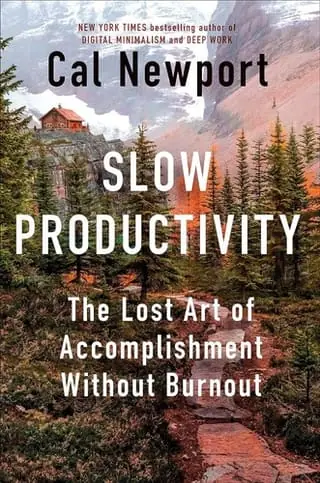
Slow Productivity summary
by Cal Newport · 2024 · 6 key ideas · 15-minute read
Escape burnout by doing fewer things, working at a natural pace and obsessing over quality, instead of measuring your worth by visible busyness.
Why read it
For knowledge workers who are overloaded and exhausted despite working hard. It offers a more sustainable definition of productivity, with practical tactics for getting there.
Slow Productivity in brief
Newport argues that knowledge workers are burning out because of a hidden assumption he calls pseudo-productivity: using visible activity as a proxy for real productive effort. Because knowledge work rarely has clear output measures, being busy, answering emails quickly and attending meetings became the way to look productive. Email, chat and video calls made this far easier, and far more exhausting.
As an alternative, he proposes slow productivity: a philosophy for organising knowledge work in a sustainable and meaningful way, based on three principles. Do fewer things. Work at a natural pace. Obsess over quality.
Newport draws heavily on 'traditional knowledge workers', writers, artists, scientists and philosophers, who often produced brilliant work at an unhurried pace. Their careers, he argues, show that meaningful output over years matters more than frantic activity in any given week.
Each principle comes with concrete tactics: limit your projects and missions, use pull-based systems for incoming work, double your timelines, work in seasons, and refine your taste so that the work you do produce is excellent. Together, he argues, they make work both more sustainable and more valuable.
The 6 key ideas
1. The trap of pseudo-productivity
Busy is not the same as productive.
2. Do fewer things
Fewer at once means more finished.
3. Pull, don't push
Pull work in when you're ready; don't let it be pushed.
4. Work at a natural pace
Important work grows at its own pace.
5. Obsess over quality
Quality buys you the freedom to slow down.
6. Rethink busyness at work
Fix the system, not just yourself.
Read the full guide in Kinquire. Every idea with a real example, a diagram and one thing to try today, plus a quick quiz so it sticks. Free to start.
Read Slow ProductivityKey takeaways
- Measure your week by what you produced, not how busy you felt.
- Limit active projects and keep the rest in a holding list.
- Plan important projects on longer timelines.
- Build quieter seasons into your year where you can.
- Study excellent work in your field to sharpen your taste.
Our take
Slow Productivity offers a humane, clear alternative to burnout culture and gives the vague feeling of 'too much' a name: pseudo-productivity. Its tactics, such as limiting projects and using pull-based systems, are useful. But it leans on examples of writers and artists with unusual freedom, and many employees lack the power to work in seasons or double timelines. Some readers find it repeats themes from Deep Work. Still, its argument that quality and focus beat visible busyness is persuasive and timely.
About Cal Newport
Cal Newport is a computer science professor at Georgetown University and the author of Deep Work, Digital Minimalism and other books on work and technology.
If you liked this
- Deep Work by Cal Newport
- Four Thousand Weeks by Oliver Burkeman
- So Good They Can't Ignore You by Cal Newport
- Atomic Habits by James Clear
- The Power of Habit by Charles Duhigg
- The 7 Habits of Highly Effective People by Stephen R. Covey