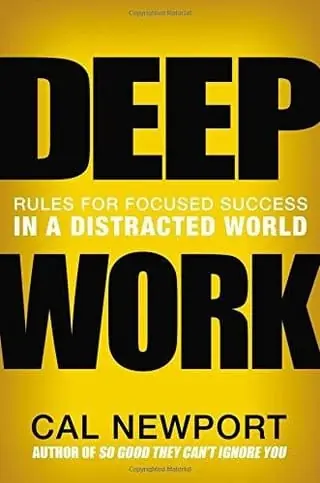
Deep Work summary
by Cal Newport · 2016 · 8 key ideas · 20-minute read
The ability to focus without distraction on hard things is becoming rare just as it becomes most valuable, so train it and build your life around it.
Why read it
For knowledge workers, students and creators who feel busy all day yet rarely produce work they are proud of. It gives both a strong argument for focus and a practical system for getting more of it.
Deep Work in brief
Newport splits work into two kinds. Deep work is done in distraction-free concentration that pushes your mind to its limit and creates new value that is hard to copy. Shallow work is logistical, easy to replicate, and usually done while distracted: email, meetings, quick replies. His central claim, the Deep Work Hypothesis, is that deep work is becoming rarer at the very moment it is becoming more valuable.
It is valuable because a changing economy rewards people who can learn hard things quickly and produce at an elite level, and both require intense focus. It is rare because modern workplaces drift toward constant connection: open offices, instant messaging and social media. Since the cost of distraction is hard to measure, busyness becomes the easy stand-in for productivity. Depth is also meaningful: a life spent absorbed in challenging work tends to feel better than one spent skimming.
The second half of the book offers four rules. Work deeply, by choosing a scheduling philosophy, building rituals and protecting your downtime. Embrace boredom, because a mind used to constant novelty cannot concentrate on demand. Quit social media, or at least choose tools like a craftsman who only keeps what clearly earns its place. And drain the shallows, by scheduling every minute, measuring how deep each task is and capping the shallow work you accept.
The overall message: concentration is a skill, not a personality trait, and it can be trained. Anyone who builds a life around regular stretches of deep work gains an advantage that most of their peers have quietly given up.
The 8 key ideas
1. Rare and valuable
If everyone is skimming, the one who can dive wins.
2. Attention residue
A quick check is never quick: it leaves residue.
3. Choose your depth philosophy
Don't wait to feel focused. Schedule it.
4. Rituals and grand gestures
Same place, same start, same rules: focus arrives faster.
5. Embrace boredom
Boredom is the gym where focus gets strong.
6. Craftsman tool selection
Not 'is it useful?' but 'is it worth what it costs?'
7. Drain the shallows
Give every hour a job, or someone else will.
8. Be lazy on purpose
Shut down fully so you can switch on fully.
Read the full guide in Kinquire. Every idea with a real example, a diagram and one thing to try today, plus a quick quiz so it sticks. Free to start.
Read Deep WorkKey takeaways
- Track your deep hours each week and try to raise the number gradually.
- Choose a depth philosophy (rhythmic is easiest) and put fixed deep blocks in your calendar.
- Schedule internet breaks instead of focus breaks, and tolerate boredom in small daily moments.
- Keep a tool only if it clearly serves your core goals; try a 30-day social media break.
- Time-block every workday and end with a shutdown ritual.
Our take
Deep Work names a real problem and gives concrete tools that many readers find life-changing, especially time blocking and the shutdown ritual. Its weakness is that it assumes a level of autonomy many workers do not have; parents, junior staff and anyone in a service role may struggle to apply the monastic or bimodal approaches. Some research it leans on, such as studies of media multitasking, has had mixed follow-ups. Still, the core idea has aged well: as notifications and AI tools multiply, the ability to concentrate looks more valuable, not less.
About Cal Newport
Cal Newport is a computer science professor at Georgetown University. He has written several books on work and technology, including So Good They Can't Ignore You and Digital Minimalism.
If you liked this
- Digital Minimalism by Cal Newport
- Slow Productivity by Cal Newport
- Flow by Mihaly Csikszentmihalyi
- Indistractable by Nir Eyal
- Atomic Habits by James Clear
- The Power of Habit by Charles Duhigg